
What Do Gorillas Eat?
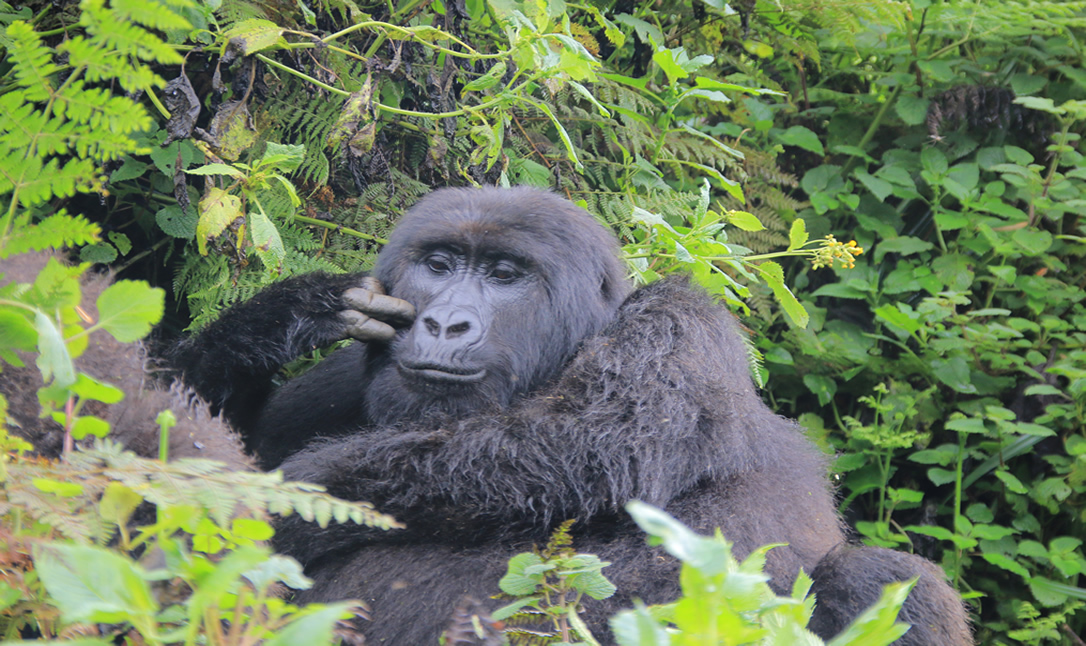
What Do Gorillas Eat? : Planning a gorilla trekking safari in Uganda, Rwanda, or the Democratic Republic of Congo comes with plenty of questions and moments, however one of the most rewarding moments you will experience is viewing a mountain gorilla eat.
Not from behind glass like in a zoo, but in the wild pulling bamboo shoots from the earth, stripping bark with powerful hands, and chewing with the calm, unhurried rhythm of an animal completely at home in its world.
Understanding what gorillas eat transforms that moment from passive observation into genuine understanding. It answers why they move where they move, why the forests they live in must be protected, and why a gorilla’s relationship with its habitat is one of the most beautifully balanced arrangements in the natural world.
What do gorillas eat?: This guide covers everything you need to know the science, the species differences, the seasonal shifts, and the real-life things you are likely to witness on the trail.
Gorillas Are Primarily Herbivores.
The short answer to what gorillas eat is this: plants. Gorillas are overwhelmingly herbivorous, drawing almost everything they need from leaves, stems, roots, bark, shoots, flowers, and fruit. But leaving it there would be like saying the Amazon rain forest is just a collection of trees. The detail is where the fascination lives.
Gorillas are, divided into two species the Eastern gorilla (Gorilla beringei) and the Western gorilla (Gorilla gorilla). Each species is further divided into two subspecies: Eastern gorillas into mountain gorillas (Gorilla beringei beringei) and Eastern lowland (Grauer’s) gorillas (Gorilla beringei graueri); Western gorillas into western lowland gorillas (Gorilla gorilla gorilla) and the critically endangered Cross River gorillas (Gorilla gorilla diehli).
Each of these subspecies eats differently, shaped entirely by the forest it inhabits. Altitude, rainfall, temperature, and seasonal fruit availability all determine what ends up in a gorilla’s mouth on any given day.
What Mountain Gorillas Eat
Mountain gorillas, the ones most travellers encounter on safari in Uganda’s Bwindi Impenetrable National Park and Mgahinga Gorilla National Park, or in Rwanda’s Volcanoes National Park, live at elevations between 2,200 and 4,300 metres above sea level. At those heights, fruit-bearing trees are scarce. The gorillas have adapted accordingly.
Approximately 85 to 86 percent of a mountain gorilla’s diet is made up of leaves, stems, shoots, and pith drawn from as many as 142 plant species. Fruit accounts for only about 1.7 to 3 percent of their intake a remarkably small proportion for a great ape. The rest of the diet is filled out with roots, flowers, bark, and on rare occasions, small invertebrates.
The Key Food a s Mountain Gorillas Eat
Leaves and stems form the daily foundation. Mountain gorillas are selective feeders. They seek out young, tender growth newer leaves are lower in tannins and easier to digest. You will often see gorillas working methodically through patches of vegetation, choosing the softer, younger growth over the older, tougher material a metre away. It looks casual, but it is highly deliberate.
Wild celery (Peucedanum linderi) is a particular favourite in Bwindi and appears consistently across research studies as a preferred food. Travellers frequently spot gorillas pulling and chewing these stalks during the one-hour encounter.
Bamboo shoots are a seasonal delicacy, highly prized in Volcanoes National Park in Rwanda, where bamboo forest covers a significant portion of the lower elevations. When the rains come and new bamboo pushes through the ground, gorillas may travel specifically to take advantage. The shoots are nutrient-dense and relatively soft something like asparagus in nutritional terms. If your trek happens to fall during bamboo season, watching gorillas excavate and consume these shoots is something genuinely memorable.
Roots and bark provide important minerals and serve as backup nutrition when preferred foods are less available. Gorillashave strong, specialised teeth and powerful jaw muscles suited precisely to this kind of fibrous, demanding food. The canines you will notice are not for predation they are primarily for social signalling among males.
Flowers are eaten when available, adding variety and some natural sugars to an otherwise savoury diet.
Insects mostly termites, ants, and their larvae are consumed occasionally and opportunistically. This is not hunting behaviour in any meaningful sense. A gorilla may flip a log, discover a termite colony, and eat what it finds. This small protein supplement makes up only a tiny fraction of the overall diet.
Soil is eaten periodically as well. This practice, known as geophagy, is believed to help neutralise plant toxins and supplement minerals, particularly potassium, calcium, and sodium, that are difficult to obtain in adequate quantities from vegetation alone.
What Western Lowland Gorillas Eat
Western lowland gorillas live in the dense tropical rainforests of Central and West Africa countries like Cameroon, Gabon, the Republic of Congo, and Equatorial Guinea. Their environment is fundamentally different from the mountain gorilla’s highland forest, and their diet reflects this completely.
Fruits cover a big portion of what the western lowland gorilla’s diet. The lowland forest is rich in fruit-bearing trees and the availability is far greater than anything a mountain gorilla encounter. Seeds account for around 17 percent of their diet, leaves and stems for a further 17 percent, and caterpillars, termites, and other invertebrates for roughly 3 percent.
The western lowland gorilla can feed from over 200 plant species and individual animals have been observed eating from more than 97 different species in a single area. Their foraging range is correspondingly larger, driven by the need to track seasonal fruit across a wider landscape.
What Eastern Lowland (Grauer’s) Gorillas Eat
The Eastern lowland gorilla, found primarily in the eastern Democratic Republic of Congo, occupies a middle ground between its mountain and western lowland cousins. It feeds on parts of over 104 plant species and its diet shifts seasonally — fruit when available, leaves and stems when fruit is scarce. A mature male Grauer’s gorilla can consume over 30 kilograms of plant material per day. Females consume around 18 kilograms daily.
How Much Do Gorillas Eat Each Day?
Gorillas are large animals with correspondingly large energy requirements. A mature silverback mountain gorilla, weighing between 140 and 200 kilograms, may consume up to 18 kilograms (approximately 40 pounds) of vegetation per day. They spend roughly half of their waking hours foraging and eating, with the remainder split between resting, socialising, and moving between feeding areas.
This constant consumption is not gluttony it is necessity. Plant material is low in calories per kilogram compared to meat. To sustain a body of that size on leaves and stems requires processing enormous volumes of food. The gorilla’s digestive system is accordingly long, with an enlarged colon that extracts maximum nutrition from fibrous material through extended fermentation.
Do Gorillas Drink Water?
This surprises many people. Gorillas rarely drink water directly, even when streams and rivers are nearby. They obtain the majority of their hydration from the moisture content in fresh vegetation leaves, stems, and fruit contain significant water.
Dew collected on leaves in the early morning also contributes. In the rare cases where gorillas do drink from streams or rivers, they typically use their hands or drink directly from cupped leaves rather than bending to the water’s surface.
Seasonal Shifts: How Gorilla Diets Change Through the Year
Gorilla diets are not fixed. They shift with the seasons in ways that directly affect where gorillas are found and what travellers are likely to observe during a trek.
During the rainy seasons (April to May and October to November) in Uganda and Rwanda vegetation is abundant, bamboo shoots emerge, and gorillas often remain in more concentrated areas with reliable food. The trekking terrain is muddier and more challenging, but encounters can be rich.
During the dry seasons (June to August and December to February )gorillas may range more widely as they seek food across a broader area. Guides track the groups daily, so you will still find them, but the foraging behaviour you observe may differ. Bark and roots become more prominent in the diet when softer vegetation is less available.
The best time to visit for comfortable trekking conditions is the dry season, though spectacular encounters happen year-round.
What You Will Actually See Gorillas Eating on Safari
When your guide brings your group within metres of a gorilla family during that precious one hour encounter, feeding behaviour is one of the most common and rewarding things to observe. Here is what to look for:
Selection behaviour. Watch how a gorilla approaches vegetation. It does not simply grab the nearest thing. It tests, sniffs, selects, and discards. Younger gorillas watch adults closely to learn what to eat a process of dietary education that plays out in plain view.
Processing technique. Gorillas are dextrous. Watch how they strip bark with their fingers, fold large leaves before eating them, or extract the soft inner pith of a plant stem. Their hands work with a precision that feels deeply familiar.
Silverback priority. In most groups, the dominant silverback has first access to the best food sources. Other group members females, juveniles, younger males feed in proximity but generally defer. Social hierarchy shapes every feeding session.
Juveniles learning. Young gorillas often steal bites from their mothers or investigate food sources with the clumsy enthusiasm of children at a meal. This is one of the most charming aspects of any encounter.
Bamboo excavation. If you trek in Volcanoes National Park during the bamboo season, you may witness gorillas pushing aside soil and leaf litter with their knuckles to expose fresh shoots. The efficiency and strength involved is something you will not forget.
Why Gorilla Diet Matters for Conservation
A gorilla’s diet is inseparable from te health of the forest it lives in. Mountain gorillas require large, intact forest ecosystems to survive. The 142 plant species that mountain gorillas feed on do not exist in fragments they require continuous forest with elevation gradients, seasonal variation, and the biological complexity that only old, undisturbed ecosystems provide.
When forests are cleared for agriculture or settlement, gorillas lose not just shelter but food diversity. The narrowing of dietary options weakens populations over time. Protecting gorilla habitat is not an abstract conservation principle it is a direct protection of the gorillas’ ability to eat, thrive, and reproduce.
Every gorilla trekking permit purchased in Uganda or Rwanda contributes directly to conservation funding. In Bwindi, a portion of permit revenue is returned to local communities surrounding the park, creating an economic incentive for forest protection that has proven to be one of the more successful conservation models on the continent.
Practical Tips for Travellers: Getting the Most From the Feeding Encounter
- Move quietly. Gorillas feeding in a relaxed state are far more likely to remain calm and continue natural behaviour if the group of visitors is still and quiet. Sudden movement or noise can interrupt a feeding session and cause the group to shift position.
- Keep your distance initially.
- In presence of the gorillas you are asked to keep a distance of 7metres away from the gorillas. This is both for your safety and the gorillas’ protection from human respiratory diseases. Follow the guide’s lead on movement.
- Watch the whole group, not just the silverback. Feeding behaviour varies enormously across the group. Mothers, juveniles, and adolescents all interact with food differently and provide some of the most interesting observations.
- Bring good optics. A pair of binoculars allows you to see exactly what a gorilla is selecting to eat from a distance, which adds depth to the experience even when an animal is several metres away.
- Ask your guide. The naturalist guides assigned to each trekking group know the specific food preferences of their gorilla family, what is currently in season, and what the gorillas have been eating in recent days. These guides are extraordinary sources of knowledge, and their insight transforms a wildlife viewing moment into genuine natural history education.
Final Word
Gorillas eat plants but behind that simple fact lies one of the most sophisticated relationships between a large mammal and its environment that exists anywhere on Earth. Their diets are precisely calibrated to the forests they inhabit, fine-tuned over millions of years of evolution, and deeply vulnerable to the disruptions that human activity brings.
When you sit in the forest and watch a mountain gorilla carefully select a stem, strip it with patient hands, and chew with what looks remarkably like contentment, you are watching a creature that is simultaneously immensely powerful and deeply dependent on its family, its forest, and ultimately, on the decisions that humans make about how much of that forest survives.
That is the quiet argument for every gorilla safari. It is not just the encounter that matters. It is what you understand when you walk back out of the trees.
Company
Gorilla Safaris Africa is one of the leading experts to trust while you are seeking for unforgettable and gorillas safaris with in Africa.
Features
Most Recent Posts
- All Post
- Combined Safaris
- East Africa
- Gorillas
- Luxury Safaris
- Primates Safaris
- Wildlife