
Gorilla Trekking in Rwanda
The Complete Guide to the Land of a Thousand Hills’ Greatest Adventure
Rwanda does not do things quietly. In just three decades, this small, landlocked East African nation has transformed itself into one of the continent’s most admired destinations safe, clean, extraordinarily well-organised, and home to a conservation story that the world is still catching up to. At the centre of that story is the mountain gorilla. Rwanda’s Volcanoes National Park shelters roughly a third of the world’s remaining mountain gorilla population, and trekking to meet them in the mist-shrouded Virunga volcanoes is an experience that simply has no equal. This is everything you need to know before you go.
The Experience Itself
The alarm goes off before five in the morning. You are gathered at the headquarters of Volcanoes National Park in Kinigi, a small town at the base of the Virunga mountains, joining fellow trekkers for the briefing. The atmosphere is charged first-timers anxious and wide-eyed, returning visitors quietly confident in what lies ahead. Rangers divide the group in to 8 people according to which habituated gorilla family each set of trekkers has been assigned to, deliver a careful briefing on protocol, and answer last-minute questions.
Then the vehicles roll up the mountain, and the trek begins.
Volcanoes National Parkcontains twelve habituated gorilla families, each tracked daily by dedicated monitoring teams. The diversity of families means experiences vary enormously from one group to the next. Some families, like the famous Susa group one of the largest in the Virungas require treks of four to six hours through dense hagenia forest and bamboo zones at altitude. Others, like the Amahoro or Umubano families, are typically reached in two hours or less. There is no way to know in advance how long your trek will take; the gorillas roam freely, and the trackers radio ahead with updated coordinates as you move through the forest.
The terrain in Volcanoes National Park is demanding but arguably more varied and visually stunning than anywhere else in gorilla country. You ascend through farmland and then into layered forest first bamboo groves that creak and sway above you, then ancient hagenia trees draped in old-man’s beard lichen, then open volcanic meadows above the treeline if the gorillas have moved high. The Virunga volcanoes — Karisimbi, Bisoke, Muhabura, Sabyinyo, Gahinga loom through the cloud around you. It is genuinely otherworldly.
And then the trackers stop. They exchange a glance. They point into the undergrowth. And there they are.
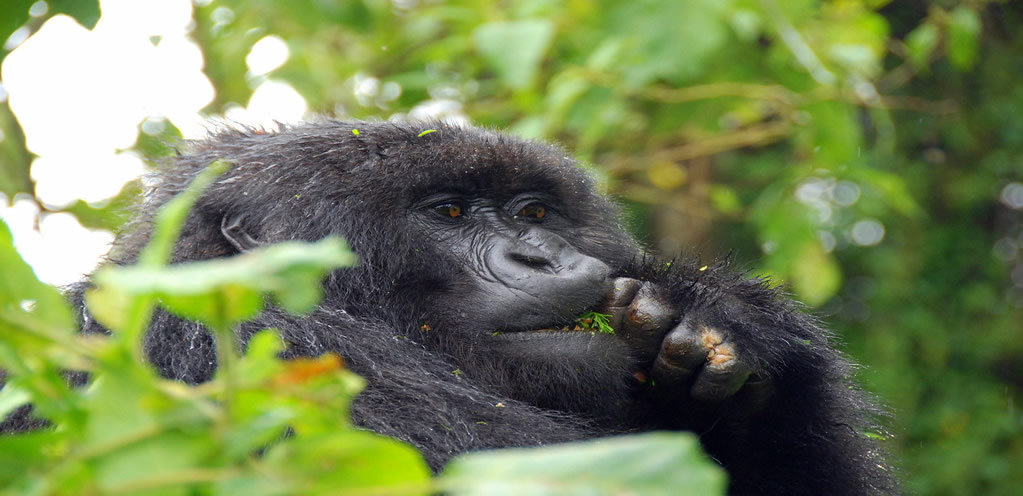
The one-hour rule applies here as in Uganda sixty minutes with the gorillas, enforced strictly by the guides. But in that hour, the world narrows to this: a silver back grooming his flank in a shaft of forest light; juveniles chasing each other through the vegetation with a recklessness that makes everyone smile; a mother cradling a newborn so tiny and dark it barely seems real. The gorillas are habituatedto human presence but entirely unbothered by it. They go about their lives with sovereign indifference to your presence, which makes the encounter feel like a privilege rather than a performance.
Rwanda’s gorilla permitis priced at $1,500 USD per person the highest in the world and significantly above Uganda’s $800 fee. The price reflects Rwanda’s deliberate positioning as a high-value, low-volume destination, and every dollar feeds back into conservation, ranger salaries, and the communities that share their land with these animals. The revenue model works: Rwanda’s gorilla population has been growing steadily for two decades, and the parks are immaculately managed.
Best Time to Go
Rwanda’s climate is shaped by its equatorial position and high altitude, producing two distinct dry seasons and two wet seasons, all of which have trekking trade-offs worth understanding.
The long dry season, June to September, is universally considered the best time to trek. Trails are firm, the vegetation is somewhat less impenetrable, and the mountain air is clear on good days, offering dramatic views of the Virunga volcanoes above the canopy. July and August are the absolute peak months — international visitors arrive in large numbers, premium lodges fill months in advance, and the energy around the park is at its highest. If you plan to trek in high season, secure your permit and lodge bookings at least six months ahead.
The short dry season, December to February, is an excellent secondary window. Trails are in good condition, permit availability is better than peak season, and the park has a quieter, more intimate atmosphere. January in particular is something of a hidden gem reliably dry, uncrowded, and offering some of the best value lodge rates of the year.
The wet seasons — March to May and October to November— bring significant rainfall and transform the trails into muddy, slippery channels that test even experienced trekkers. However, the forest in these months is extraordinary: intensely green, alive with birdsong, and wreathed in mist that gives the Virungas a primordial atmosphere unlike anything in the dry season. Permit prices remain the same year-round, but lodge rates frequently drop, and the sense of having the forest almost to yourself can make the extra effort entirely worthwhile.
The single best months for combining reliable conditions, manageable crowds, and atmospheric beauty are late June and September — the bookends of the long dry season.
Where to Stay
Accommodation around Volcanoes National Park is concentrated primarily in the Musanze area (the nearest large town) and along the road approaching Kinigi. Rwanda has leaned deliberately into the luxury market, and the high-end lodges here are among the finest wildlife properties in Africa. That said, mid-range and budget options have expanded meaningfully in recent years.
Luxury
Singita Kwitonda Lodge sits at the edge of Volcanoes National Park and is widely regarded as one of the greatest safari lodges in Africa. Twelve villas with floor-to-ceiling glass, private plunge pools, and interiors that draw on traditional Rwandan craft and geometry. The service is extraordinary and the guiding team among the most knowledgeable in the region. Full board plus game activities are included.
One&Only Gorilla’s Nestoccupies a stunning position in the forest, with ten freestanding suites designed to blur the boundary between interior and landscape. The lodge has a signature spa, exceptional cuisine drawing on Rwandan and continental influences, and a conservation programme that connects guests to ranger work in the park. A genuinely immersive property.
Bisate Lodgeby &Beyond is built into the bowl of an ancient, eroded volcano and is both architecturally dramatic and profoundly sustainable. Six spherical forest villas are set into the hillside with views over the volcanic peaks. The lodge is involved in active reforestation of the surrounding landscape, and guests are invited to participate. This is luxury with genuine purpose.
Sabyinyo Silverback Lodgeis managed in partnership with a community trust that has distributed tens of millions of dollars to surrounding villages. The lodge itself is classically beautiful — stone-and-thatch cottages, fireplaces, exceptional food — but the community ownership model makes staying here feel meaningfully different from anywhere else.
Mid-Range
Mountain Gorilla View Lodge is a long-established mid-range favourite with comfortable bungalow-style rooms, warm and attentive staff, and a welcoming communal area with views towards the volcanoes. The breakfast spread is generous, the organisation smooth, and the proximity to the park headquarters makes early morning departures entirely stress-free.
Virunga Lodgeoccupies a ridge above Lake Bulera and Lake Ruhondo with arguably the most cinematic views of any mid-range property in the area. Twelve thatched bandas are simply but tastefully furnished, and the sunset over the twin lakes with the volcanoes behind them is one of those scenes that guests talk about for years. Excellent value for what it delivers.
Da Vinci Gorilla Lodge is a newer, stylish property that has quickly developed a strong reputation among mid-range travellers. Clean rooms, reliable hot water, a thoughtful menu, and a rooftop area with mountain views. It manages to feel contemporary without sacrificing warmth.
Budget
La Palme Hotel in Musanze is a reliable budget base: clean rooms, consistent hot showers, a solid restaurant, and genuinely friendly staff. It’s in town rather than directly at the park, but the 30-minute drive to Kinigi is straightforward and easily arranged.
Amahoro Guesthouse near Kinigi is a small, community-linked guesthouse with basic but comfortable rooms and home-cooked Rwandan meals. Staying here puts money directly into the local economy and offers an authentic glimpse of daily life at the edge of the forest.
Muhabura Hotel in Musanze is a no-frills but dependable option that has served budget travellers for many years. Functional rooms, honest food, and an efficient front desk that handles park logistics without drama.
What to Pack
The packing list for Rwanda closely mirrors that of any serious gorilla trek, with a few Rwanda-specific considerations worth noting.
ClothingLong trousers and long-sleeved shirts in neutral colours — greens, khaki, brown, grey. Avoid anything blue, which attracts insects. Layering is essential: mornings in the Virungas at 2,500 metres or above are genuinely cold, and the temperature can shift dramatically within a single trek. A lightweight, packable rain jacket is non-negotiable.
FootwearWaterproof, ankle-supporting hiking boots are the single most important item you will pack. The volcanic soil in Volcanoes National Park becomes extremely slippery when wet. Break your boots in fully before travelling — blisters at altitude are a miserable distraction from everything around you.
Gardening Gloves Rangers recommend these unanimously and universally. When scrambling up steep volcanic terrain using roots, branches, and anything else within reach, thick gardening gloves protect your hands from thorns, stinging nettles, and the surprisingly sharp edges of volcanic rock.
GaitersPull-on gaiters worn over boots and lower trousers keep mud and stinging vegetation away from your skin. Unglamorous, entirely indispensable.
Trekking Poles Some lodges provide them; bringing your own collapsible set is worth the luggage space. The descents in Volcanoes National Park can be steep and slick, and poles dramatically reduce the load on your knees.
Daypack Contents Carry at least two litres of water, high-energy trail snacks, a small first aid kit with blister plasters and antiseptic, DEET insect repellent, sunscreen (the equatorial sun is powerful even through cloud), and a dry bag or waterproof pack cover for your gear.
Camera Equipment A camera with strong low-light capability is worth prioritising over zoom range — the forest floor is frequently dim. A 70–200mm lens covers most situations comfortably. Carry spare batteries and memory cards. No flash is permitted in the presence of the gorillas.
Documents and Cash Carry your permit documentation and passport. Bring USD cash for tipping — porters typically receive $10–15 per trek, guides $20–30. Porters are available for hire at the trailhead and are worth every dollar: they carry your bag, steady you on difficult sections, and are often invaluable sources of local knowledge.
A Final Word
Rwanda has earned its reputation as Africa’s most meticulously managed wildlife destination. The permit is the most expensive in the world, the lodges among the most refined on the continent, and the conservation outcomes among the most impressive anywhere. But strip all of that away, and what you are left with is this: a mist-covered volcanic forest, a silver back moving through the undergrowth, and sixty minutes that will stay with you for the rest of your life.
Company
Gorilla Safaris Africa is one of the leading experts to trust while you are seeking for unforgettable and gorillas safaris with in Africa.
Features
Most Recent Posts
- All Post
- Combined Safaris
- East Africa
- Gorillas
- Luxury Safaris
- Primates Safaris
- Wildlife