

Are there silver back gorillas in Africa: Few creatures on Earth command as much wonder and reverence as the silverback gorilla. Towering, powerful, and surprisingly gentle in demeanor, these magnificent animals have captured human imagination for centuries. But a question that continues to surface among wildlife enthusiasts, travelers planning safaris, and curious minds across the globe is a deceptively simple one: Are there silverback gorillas in Africa?
The answer is yes, gorillas can only be spotted in Africa and silverbacks ate dominant males that rule a particular group. But the whole story is much more complex, important, and urgent than a one-word answer can show.
It requires one to know where these gorillas live, why they are important, how to protect them and many more. This is important for anyone who really wants to appreciate one of humanity’s closest living relatives.
This article presents detailed information about silverback gorillas in Africa as well as covering their, subspecies, ecology, social structure, and the conservation challenges that make every surviving individual precious beyond measure.
What Exactly Is a Silverback Gorilla?
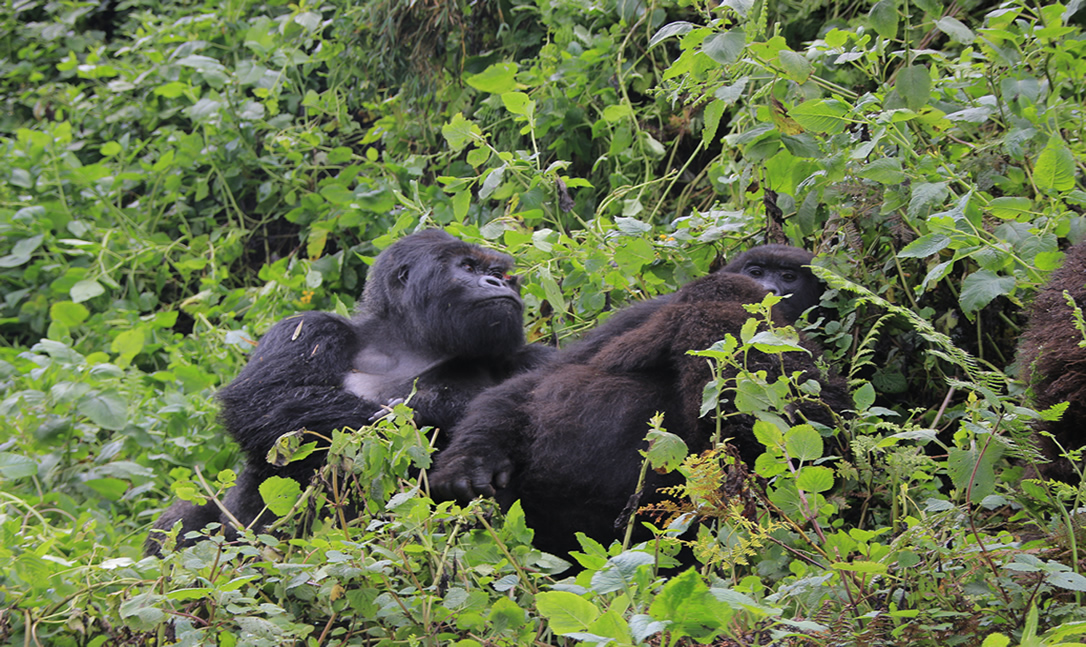
A silverback is not a separate species of gorilla. They refer to mature male gorilla typically aged ten years or older whose back has developed a distinctive saddle of silver or grey hair. Silver backs tend to grow their silver-grey hair because of its aging and analogus texture
Silver backs are pronuoned male mature at the ages of eight to twelve years since its the time when the silver coloration tends to nurture around. During the adulty hod stage, the silver colour increases much on its back which makes it very identical from th other gorillas.
The silverbacks are the main leaders of a particular gorilla troop. They dominate every things for the group such as where to travel, when to rest, where to get what to eat as well as protecting every member of the family. Adult silverbacks tend to weigh around 136 kilograms (300 pounds) and 227 kilograms (500 pounds), standing nearly 1.8 meters (6 feet) tall when upright.
Their authority is rarely challenged without consequence, and their physical presence alone is often enough to deter potential rivals or predators.
Yes, Silverback Gorillas Are Found in Africa
Silver backs are completely endemic to Africa implying that now where apart from Africa can be traced. However silverbacks are mainly found in separate regions of the sub- Saharan Africa.1. The Western Region
The western population of gorillas is divided into two subspecies:
Western Lowland Gorilla (Gorilla gorilla gorilla) : This is the most numerous gorilla subspecies on Earth and the one most commonly found in zoos around the world. Western lowland gorillas inhabit the dense tropical rainforests and swampy lowland forests of six countries: Cameroon, the Central African Republic, the Democratic Republic of Congo (DRC), Equatorial Guinea, Gabon, and the Republic of Congo. Gabon alone is thought to host the largest single population.
Despite being the most numerous subspecies, western lowland gorillas are still classified as Critically Endangered by the International Union for Conservation of Nature (IUCN). Population estimates suggest that fewer than 100,000 individuals remain in the wild, though surveying these animals in dense, remote forest is notoriously difficult.
Cross RiverGorilla (Gorilla gorilla diehli): This is one of the rarest species of the great apes that can be seen on earth. They are about 200 to 300 of these animals left in the forests in countries like Nigeria and Cameroon. Due to their least numbers in the whole world, these species are vulnerable to any harms such as poaching and habitat loss.
The Eastern Region
The eastern gorilla population is similarly divided into two subspecies:
Eastern Lowland Gorilla (Gorilla beringei graueri) : Generally known as Grauer’s gorilla, this is the largest gorilla subspecies by body size. Found exclusively in the eastern Democratic Republic of Congo.
These gorillas inhabit montane and lowland forests across a range that has been dramatically reduced over the past three decades due to armed conflict, artisanal mining, and agricultural expansion.
Their population has plummeted by more than 77 percent since the 1990s, with current estimates placing the total at fewer than 4,000 individuals. They are classified as Critically Endangered.
Mountain Gorilla (Gorilla beringei beringei) Perhaps the most iconic of all gorilla subspecies, mountain gorillas inhabit the volcanic Virunga Mountains a range shared across Uganda, Rwanda, and the Democratic Republic of Congo as well as the Bwindi Impenetrable Forest in Uganda.
These gorillas live at elevations ranging from 2,200 to 4,300 meters above sea level and have adapted to cooler, misty environments compared to their lowland relatives.
Mountain gorillas are the subject of some of the world’s most intensive and successful conservation programs.As of the most recent surveys, approximately 1,063 mountain gorillas survive in the wild a remarkable recovery from fewer than 700 individuals counted in the early 2000s.
This makes them one of the rare success stories in great ape conservation, though they remain classified as Endangered.
The Role of the Silverback Within Gorilla Society
Silver backs play a very big role in a particular gorilla family. Gorillas live in groups called troops, which are made up of one dominant silverback, several females, their young, and sometimes one or two subordinate males called blackbacks. Sometimes, larger troops have more than one silverback, like a father and his grown sons, but the social order is still very clear.
The silverback has a lot of important duties it does with in a particular family.
Diet and Daily Life : Gorillas are primarily herbivores with a diet that varies considerably by subspecies and habitat. Mountain gorillas rely heavily on leaves, stems, bark, and roots the vegetation of high-altitude forests.
Western lowland gorillas, living in areas with richer fruit availability, consume significantly more fruit and have been documented eating over 200 different plant species, along with insects such as termites and ants.
A silverback, owing to his sheer body mass, may consume up to 34 kilograms (75 pounds) of vegetation in a single day.
This voracious appetite means that gorilla troops must cover substantial ground daily typically between 0.5 and 1 kilometres, though sometimes more in search of adequate food.
Gorillas construct fresh sleeping nests each night, either on the ground or in low tree branches, using bent and woven vegetation. The silverback almost always sleeps on the ground, a behavioral choice consistent with his role as the first line of defense for the group.
Gorilla Intelligence and Emotional Complexity
Researchers are still amazed by how smart gorillas are, even though they share about 98.3% of their DNA with humans. Research centers and the wild have both shown that gorillas:
Use resources in captivity and have been seen using sticks to measure how deep the water is in the wild.
Show that you are aware of yourself by passing the mirror self-recognition test in certain situations.
Show a wide range of emotions, such as sadness, happiness, curiosity, and deep love for family members.
Talk to each other by making sounds, making faces, standing up straight, and beating your chest.
Learn sign language. Koko, a western lowland gorilla, famously learned over 1,000 signs and used them to communicate. Some records show silverbacks adopting orphaned babies, caring for disabled members of their group, and forming lifelong bonds with certain females and their babies.
Threats to Silverback Gorillas in Africa
Despite silverbacks being strong and big there are certain threats that completely hinder their presence.
The primary dangers include:
Habitat Loss: This is one of the main threats to silverbacks in Africa. Fragmentation of forests separates gorilla groups, which lowers genetic diversity and makes recovery harder. Different human activities such as Commercial logging, farming, charcoal production, and human settlement are all lead to deforestation thus causing habitat destruction
Poaching: Regardless of Gorillas being protected by law in all of their habitats, but poaching is still a big problem. People sometimes kill adult gorillas, including silverbacks, for bushmeat. People catch babies for the illegal pet trade, which often costs the lives of several adults because troop members will fight to protect their young.
Disease infections: One of the rampant threats to silver backs in Africa. Gorillas are very likely to get sick from humans, including COVID-19, Ebola virus disease, and respiratory illnesses. One disease outbreak can wipe out a whole population. Because gorilla habitats are close to where people live, disease transmission is always a worry.
Political Instability and Armed Conflict: Decades of armed conflict have affected a lot of the gorillas’ range, especially in the eastern DRC. In areas where there is active fighting, it is almost impossible to do conservation work. Sometimes, combatants even hurt gorillas in protected areas.
Climate Change: Changes in temperature and rainfall patterns can affect the availability of food plants and may change how diseases spread, putting even more stress on already stressed populations over time.
Conservation Efforts: What Is Being Done
The picture is not entirely bleak. Africa is filled with plenty of dedicated conservation organizations, governments, and local communities that are working extensively to protect gorilla species.
The Dian Fossey Gorilla Fund, established in honor of the pioneering researcher who spent 18 years studying mountain gorillas in Rwanda before her murder in 1985, continues to monitor and protect gorilla populations in both Rwanda and the DRC. Fossey’s work fundamentally changed scientific understanding of gorilla behavior and laid the groundwork for modern gorilla conservation.
Gorilla ecotourism has proven to be one of the most effective conservation tools developed. Gorilla permits in Uganda and Rwanda cost $ 800 and $ 1500. The gorilla permit price has a portion that goes to various community development programs, a habitat protection and many more. This helps to create a powerful economic incentive for local communities to support rather than exploit gorilla populations
The Wildlife Conservation Society (WCS), World Wildlife Fund (WWF)and numerous national and international NGOs also operate programs across western and central Africa. They mainly work hard to ensure vast protection of the gorillas.
Where to See Silverback Gorillas in Africa
Are there silverback gorillas in Africa: For those who wish to witness silverback gorillas in their natural habitat, several destinations offer regulated, responsible wildlife tourism such as
- Bwindi Impenetrable National Park (Uganda) This is among the incredible gorilla trekking destinations in Africa. With nearly half of the world’s mountain gorillas with plenty of gorilla trekking sectors. Trekking gorillas in Bwindi is completely a dream come true.
- Volcanoes National Park (Rwanda): This is a top gorilla trekking destination in Africa. And a very bio diverse area. Volcanoes national park is an ideal place for luxury trekkers. The park is very accessible just 2 hours from Kigali.
- Virunga National Park, Democratic Republic of Congo Africa’s oldest national park and a UNESCO World Heritage Site, though access can be complicated by regional security conditions.
- Mgahinga Gorilla National Park, Uganda : Seeking for a less crowded area for exceptional gorilla trekking experiences Mgahinga is on your top bucket list. The park is a perfect place for trekking since its a home to both gorillas and golden monkeys.
Please note that once you attain a gorilla permit, you have directly funded the conservation programs and initiatives thus preserving gorillas in their near by futures.
Conclusion
Silverback gorillas are very much present in Africa and their presence is both a privilege and a responsibility. These extraordinary animals, found only in the rainforests and montane regions of central and eastern Africa, are living proof of the extraordinary diversity of life that this continent sustains. Every silverback represents not merely an individual animal, but the accumulated wisdom, social bonds, and genetic heritage of an ancient lineage.
Their survival, however, is not guaranteed. It depends on the will of the politicians, money from other countries, involvement from the local population, responsible tourism, and a shared desire to safeguard what is left of Africa’s vast forests. The slow but steady recovery of the mountain gorilla shows that conservation works when it is done with dedication and thoughtfulness.
If you ask if are there silverback gorillas in Africa, you will open the door to one of the most interesting stories in the natural world. This story is about power and vulnerability, scientific discovery and human responsibility. Additionally you will learn about the connection between people and their closest wild relatives. People are in charge of the silver back’s destiny, just like they are in charge of most of Africa’s natural heritage.
Company
Gorilla Safaris Africa is one of the leading experts to trust while you are seeking for unforgettable and gorillas safaris with in Africa.
Features
Most Recent Posts
- All Post
- Combined Safaris
- East Africa
- Gorillas
- Luxury Safaris
- Primates Safaris
- Wildlife