

Mgahinga Gorilla National Park: There are places that earn their reputation slowly, accumulating evidence across years until the world catches up. And then there are places that make their case in a single morning the kind of morning where you push through dense bamboo at altitude, your breath visible in the cold mountain air, and emerge into a small clearing to find a silverback gorilla watching you from a distance of four metres with an expression of such composed authority that every previous understanding you had of what a wildlife encounter could be simply dissolves.
Mgahinga Gorilla National Park is that kind of place.
Tucked into the extreme southwestern corner of Uganda, where the borders of Uganda, Rwanda, and the Democratic Republic of Congo converge at the peaks of three ancient volcanoes, Mgahinga is the country’s smallest national park a compact 33.7 square kilometres of montane forest, bamboo zone, and volcanic moorland set between 2,227 and 4,127 metres above sea level. It is also, in its particular way, one of the most concentrated wildlife experiences available anywhere in Africa.
A park where the morning can begin with mountain gorillas in the bamboo below the cloud line, continue with golden monkeys cascading through the canopy above a volcanic ridge, and end with a descent into a lava cave where the indigenous Batwa people performed ceremonies by torchlight for generations beyond counting. All of this before lunch, if you start early enough.
In this guide we have offered the necessary information about Mgahinga national park, not just the permit logistics, but the texture of the landscape, the character of the wildlife, the depth of the cultural history, and many more.
Activities at Mgahinga Gorilla National Park
Mgahinga is a park built around a small number of deeply distinctive activities. There is no game drive circuit, no boat cruise, no night drive.What the park offers instead is a handful of experiences gorilla trekking, golden monkey tracking, volcano hiking, the Batwa trail, the Garama cave each of which is genuinely extraordinary, and each of which requires a different kind of physical and mental preparation.
Gorilla Trekking
Gorilla trekking is the major highlight of a safari in Mgahinga. trekking begins with a morning briefing at Ntebeko Visitor Centre, where the ranger team explains the rules of engagement. They include staying at least seven metres from the gorillas, do not eat or drink in their presence, follow the guide’s instructions without hesitation, and keep noise to an absolute minimum.
The briefing is practical and unhurried, and it gives first-time trekkers enough context to approach the experience without anxiety.
After the briefing, the group a maximum of eight visitors per day, one of the lowest permit allocations of any gorilla trekking destination in Uganda sets out with armed rangers and experienced guides to locate the Nyakagezi family.
Trackers who move ahead of the group radio back the family’s position as it evolves through the morning, meaning the actual trekking time is variable: some days the gorillas are found within two hours, other days the terrain requires more.
The permitted hour in the presence of the gorillas passes with a speed that experienced trekkers warn you about but that is still surprising when it happens. The physical experience of the return hike gives the mind time to process what it has just witnessed, which is a process that takes considerably longer than the walk.
Gorilla permits for Mgahinga are issued by the Uganda Wildlife Authority and priced at USD 800 per person (with only eight permits available daily, advance booking is essential during peak season). The permit includes park entry, guide fees, and a community development contribution.
Golden Monkey Tracking
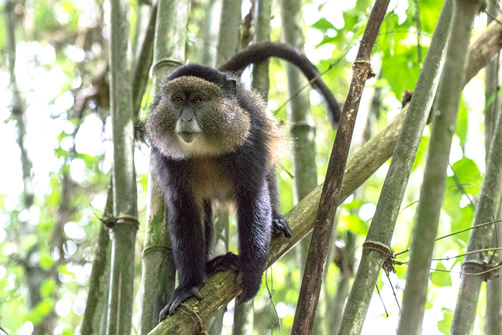
Golden monkey tracking is a separate permitted activity that can be combined with gorilla trekking on different days or, if logistics permit, on the same day in consultation with rangers. The tracking involves entering the bamboo zone with a guide to locate the habituated troop, spending a permitted hour in their presence, and returning to the trailhead.
The bamboo forest during golden monkey tracking has a particular quality of light and sound that is different from the gorilla trekking experience brighter, more open, noisier, and more unpredictable. The monkeys move faster than gorillas, vocalize constantly, and distribute themselves through the bamboo canopy in ways that require constant repositioning to follow. The photography requires different skills than gorilla trekking — quicker reflexes, more patience with movement blur, an eye for the sudden static moment when a monkey pauses on a branch and the light is perfect. The experience feels less solemn than gorilla trekking and more exhilarating in a different register.
Golden monkey permits are significantly less expensive than gorilla permits and are considerably easier to obtain at short notice. For travellers whose gorilla permit dates have been set in advance, adding golden monkey tracking on arrival is usually manageable through the Uganda Wildlife Authority office in Kisoro.
Nature walks
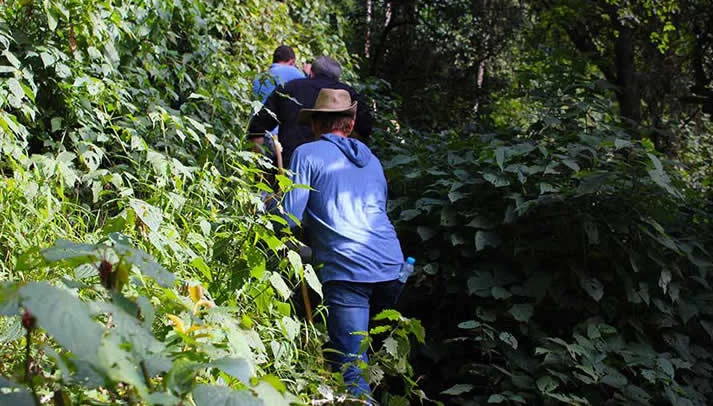
Beyond the headline activities, Mgahinga offers a network of guided nature walks of varying duration and difficulty. The Sabyinyo Gorge trail passes through some of the best birding habitat in the park, with waterfalls, moss-covered rocks, and the particular dense silence of a high-altitude gorge. The border trail runs along the lower slopes of Mount Sabyinyo near the DRC frontier a five-hour walk that passes through multiple vegetation zones and offers good chances of encountering duiker, giant forest hog, golden monkeys, and a wide range of forest birds, with the added geographical peculiarity of walking along the edge of three countries simultaneously.
A viewing platform 800 metres from the park gate provides a free, unguided introduction to the landscape, with panoramic views of the park and its volcanic skyline that require no physical exertion and no permit. It is worth thirty minutes even for travellers who have been on every major activity in the park.
The Batwa Trail
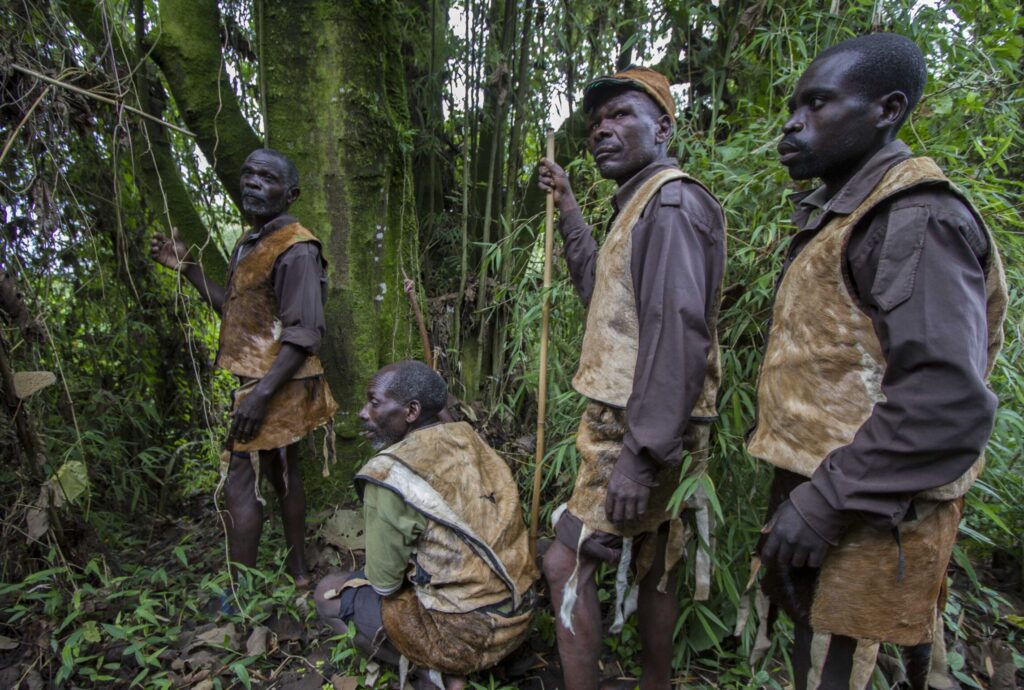
The Batwa Trail is the activity at Mgahinga that is hardest to prepare for and the one that leaves the deepest impression. It is not a comfortable experience, and it is not meant to be but it is one of the most important things Ugandan wildlife tourism currently offers, and it deserves a long and honest description.
The trail is led by Batwa guides, working on their own ancestral land for the first time in any official capacity. It runs across the lower slopes of Mounts Muhabura and Gahinga, through territory that the guides’ grandparents and great-grandparents knew with an intimacy that no subsequent generation of park rangers has matched. Along the route, the guides demonstrate the practical knowledge that sustained their people for millennia: the identification of medicinal plants, the technique of lighting fire without matches, the construction of traditional shelter, the reading of animal signs, the harvesting of honey from tree hives. It is not a performance of exotic customs for tourist entertainment; it is the transmission, in compressed form, of a way of living that is in genuine danger of being lost.
Dry Season: June to September and December to February
The dry months offer the most reliable trekking conditions. Trails are drier and firmer underfoot, the cloud that frequently wraps the volcanoes’ upper slopes tends to clear more often, and the bamboo zone that the gorillas and golden monkeys favour is more navigable without persistent rain.
The June-to-September dry season is the busiest period, and gorilla permits can be booked out months in advance. December to early February provides a quieter dry-season window that many experienced travellers prefer permit availability is generally better, accommodation rates at some properties are lower, and the park carries a quality of solitude that the peak months cannot match.
The gorillas range more widely during dry months, which can mean longer trekking times before the family is located. This is generally considered part of the experience rather than a disadvantage, as the approach through bamboo and montane forest is beautiful in its own right.
Wet Season: March to May and September to November
The long rains of March to May transform the park’s landscape in ways that have their own appeal the forest is saturated with colour and sound, waterfalls on the volcano slopes run at their most spectacular volume, and the reduced visitor numbers give successful encounters an uncommon intimacy.
Gorilla permits are considerably easier to obtain during the wet season, sometimes available at short notice. The trails become muddy and some sections genuinely slippery, requiring proper waterproof footwear, but experienced trekkers who have done Mgahinga in both conditions often describe the wet-season experience as the more primal and memorable of the two.
For volcano hiking, the wet season is less recommended.
For birding, the arrival of migratory species during the October-November period adds temporarily to the species list and makes this window particularly rewarding for dedicated birders.
Mgahinga National National Park
How to Get to Mgahinga National Park
By Road from Kampala
The standard road journey from Kampala to Kisoro covers approximately 494 kilometres and takes between nine and ten hours, making it one of the longer road transfers in Uganda’s national park circuit.
The most common route passes through Masaka and Mbarara before turning south to Kabale and then continuing to Kisoro along a road that winds through a landscape of steadily increasing drama terraced hillsides, volcanic plateaus, and eventually the first sightings of the Virunga peaks rising above the horizon.
An alternative route from Kabale follows the shoreline of Lake Bunyonyi one of the most beautiful lakes in Uganda before rejoining the main road at Muko.
This adds modest distance but subtracts considerably from the sense that you are simply enduring a transfer. Travellers with time to spare who do not yet know Lake Bunyonyi should take this route without hesitation.
By Chartered Flight
Aerolink Uganda and other regional charter operators offer flights from Entebbe to Kisoro airstrip, reducing a ten-hour road journey to approximately one hour in the air.
The aerial approach to Kisoro descending over the volcanic landscape of the Virunga region, with the three park volcanoes visible from the window is itself worth the cost of the ticket. From the airstrip, Kisoro town and the park gate are a short drive.
For travellers combining Mgahinga with Bwindi Impenetrable Forest, the charter flight option between the two parks makes this combination significantly more relaxed, allowing the full day to be spent in the park rather than in a vehicle.a
Where to Stay at Mgahinga Gorilla National Park
Accommodation options near Mgahinga are more limited than at Uganda’s larger parks — a constraint that keeps the destination intimate, controls the volume of visitors, and ensures that the landscape does not absorb more tourism pressure than it can sustain. What exists here ranges from genuine eco-luxury to community-run simplicity, and both ends of the spectrum deliver the essential requirement: proximity to the park gate for the early morning starts that gorilla trekking demands.
Mount Gahinga Lodge
The park’s premier accommodation option and the closest lodge to the Ntebeko gate, Mount Gahinga Lodge is operated as part of the Volcanoes Safaris group and consistently earns its reputation as one of the finest small lodges in southwestern Uganda. The lodge takes its design inspiration from traditional Ugandan architecture stone, thatch, and volcanic rock and integrates the natural landscape with a confidence that comes from genuine commitment to the environment.
Private cottages are comfortable and warm, with fireplaces that become necessary as the temperature drops at altitude, terraced gardens that attract forest birds to the doorstep, and views of the volcanoes that are extraordinary at dawn. The lodge has done significant work supporting the local Batwa community, establishing a cultural centre, supporting a dance group, and funding vocational training a dimension to its operation that gives staying here an additional meaning beyond personal comfort. The dining is excellent and draws on locally sourced produce.
Chameleon Hill Lodge
Located on the shores of Lake Mutanda, roughly thirty minutes from the park, Chameleon Hill offers luxury accommodation with one of the most dramatic settings in the region. The lodge looks directly across the lake to the Virunga volcanoes, and the evening light on the water with the peaks behind it is one of those views that makes you understand why people build lodges in particular places.
The slightly greater distance from the park is offset by the extraordinary environment, and Chameleon Hill works well as accommodation for travellers who want to combine gorilla trekking with canoeing on Lake Mutanda, birding, and the broader Kisoro area experience.
Lake Mulehe Safari Lodge
A mid-range option situated near the park on the shores of Lake Mulehe, this lodge offers comfortable and unpretentious accommodation with good views and reliable organisation of park activities. It is a solid choice for travellers who want the essentials done well without the cost of the luxury properties.
Travellers’ Rest Hotel, Kisoro
One of the oldest hotels in Uganda, with a history in Kisoro that predates the park itself, Travelers’ Rest has a character and a particular atmosphere that newer properties cannot manufacture. It is a mid-range hotel with large, comfortable rooms, a fireplace for cold evenings, and views of the mountains. Its place in the history of Ugandan wildlife tourism it has been receiving gorilla trekking visitors since the activity’s earliest days gives it a legitimacy that is worth something.