
How Tall Is a Silverback on Two Feet? Everything You Need to Know
How Tall Is a silver back on two feet? everything you need to know If you have ever wondered what it would feel like to stand face to face with a silverback gorilla, the answer might surprise you. These giants of the African forest are not just big they are built differently from anything else on Earth. Their height on two feet is just the beginning of the story.
This article covers everything about how tall is a silverback on two feet? everything you : exact measurements, comparisons to humans, why silverbacks stand upright, what makes their height so deceiving, and facts that most other articles simply skip.
What Is a Silverback Gorilla?
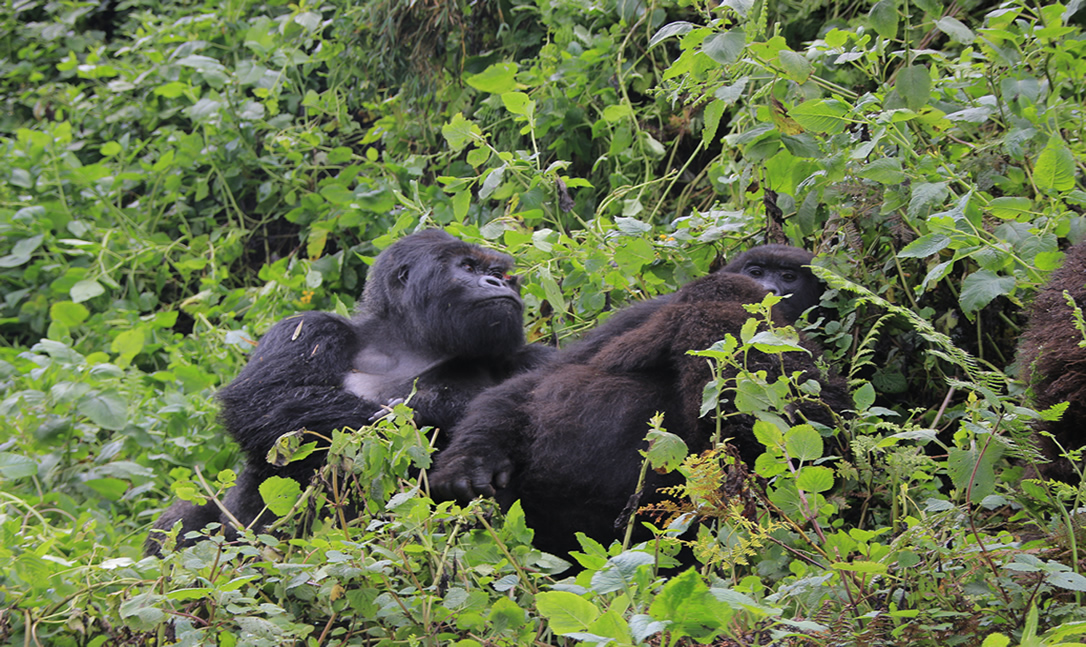
Before we talk about height, it helps to understand what a silverback actually is. A silverback is not a separate species of gorilla. It is simply a mature adult male gorilla one that has reached full sexual maturity, usually between 12 and 15 years of age. At that point, the hair across his back, shoulders, and upper thighs turns a striking silver-grey colour, which is where the name comes from.
Silverbacks are the undisputed leaders of their family groups, called troops. A troop can contain between 5 and 35 individuals, including females, young males, juveniles, and infants. The silverback decides when to eat, where to sleep, and when to move. He also defends his family from every threat leopards, rival males, and even humans sometimes at the cost of his own life.
There are two main gorilla species: the eastern gorilla and the western gorilla. Within these, mountain gorillas and eastern lowland gorillas are the largest. This matters because the height of a silverback can vary depending on which subspecies he belongs to.
How Tall Is a Silverback on Two Feet? The Exact Numbers
Here is the answer most people are searching for.
When a silverback gorilla stands fully upright on two feet, he typically reaches a height of 5.5 to 6 feet (1.7 to 1.8 meters). Some exceptionally large individuals, particularly eastern lowland gorillas, have been recorded at 6 feet 3 inches or slightly beyond.
To put that in context:
Measurement | Height |
Average silverback standing height | 5.5 – 5.9 ft (1.67 – 1.8 m) |
Exceptional individuals | Up to 6.3 ft (1.92 m) |
Tallest wild gorilla ever recorded | 6 ft (1.83 m), shot in Ambam, Cameroon |
Tallest gorilla in captivity (Gust) | 7 ft 3 in (2.20 m) at Antwerp Zoo |
Average adult human male (US) | 5 ft 9 in (1.75 m) |
So on paper, a silverback and an average man are close in height. But that is where the similarity ends completely.
Why Height Alone Does Not Tell the Full Story
This is the most important thing most articles fail to explain.
When you stand next to a silverback, you are not standing next to something of similar size. You are standing next to something built on an entirely different scale of mass.
A typical silverback weighs between 300 and 500 pounds (136 to 227 kg). The average adult man in the United States weighs around 195 pounds. That means a silverback can weigh two to three times more than a man of the same height.
While a human body is tall and relatively narrow, a silverback is wide, deep, and dense. His chest is barrel-shaped and enormously broad. His shoulders are more than twice the width of a human male’s. His neck is thick and almost seamlessly connected to his massive head. His arms hang nearly to his knees, giving him an arm span of up to 8 feet 5 inches (2.6 meters) compared to about 6 feet 2 inches for the average human male.
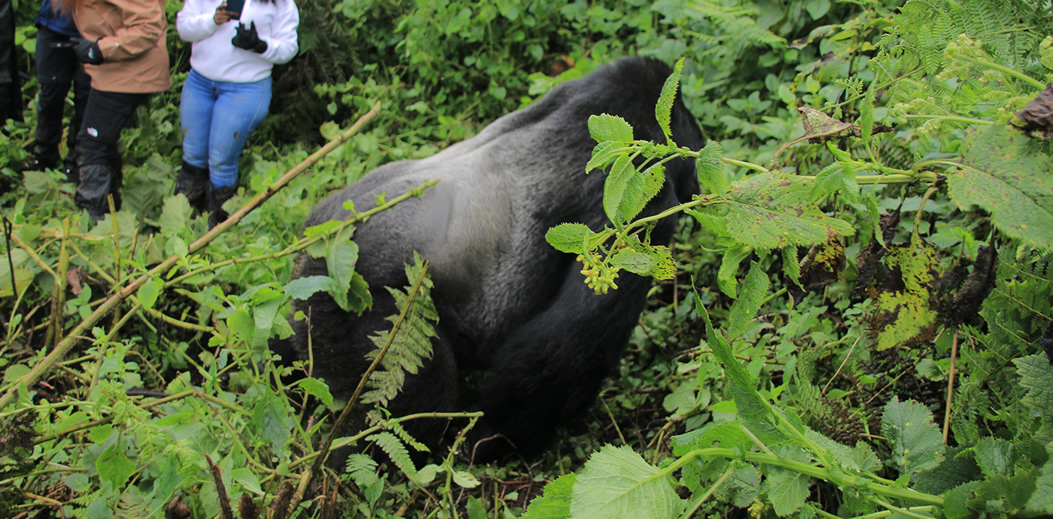
If you stood a six-foot human and a six-foot silverback side by side, the human would look thin and fragile. Researchers and wildlife photographers who have encountered silverbacks in the wild consistently report that no photograph or measurement fully prepares you for the physical presence of one standing upright just a few metres away.
Gorillas Are Not Built to Stand So Why Do They?
Here is something important that many readers miss: gorillas do not normally walk on two legs. They are knuckle-walkers, meaning they move on all four limbs, using the knuckles of their hands to support their upper body weight. When moving on all fours, a silverback reaches about 4.5 to 5 feet at the shoulder.
So why does a silverback ever stand on two feet?
There are four main reasons:
- To intimidate rivals and intruders. Standing upright makes a silverback look even larger and more threatening. Combined with chest-beating, roaring, and charging, standing on two legs is a powerful display of dominance. The full vertical height amplifies the visual threat.
- To see further.This is one of the reasons why a silverback may decide to stand for example in dense forest vegetation, it will stand for better visibility of the surrounding. Additionally, it will be able to spot danger or track the movement of his troop.
- To reach food.A silver back can still stand when it wants to obtain fruits or leaves that are a bit higher up in the trees. Standing up allows it to reach food that is a bit inaccessible.
- Out of curiosity. Gorillas are highly intelligent animals. Sometimes a silverback simply rises to get a better look at something that has caught his attention including humans on a trekking trail.
It is important to note that gorillas rarely stay fully upright for more than a few seconds at a time. Their skeletal and muscular structure is optimised for quadrupedal movement. The standing posture is a brief, purposeful act not a natural resting position.
Silverback Height by Subspecies: Not All Are the Same
Most articles treat silverback gorillas as one uniform category. In reality, there are meaningful size differences between subspecies.
Mountain gorilla (Gorilla beringei beringei):This is one of the popular subspecies of gorillas. These gorillas can be seen in Uganda, Rwanda, and the Democratic Republic of Congo. They tend to stand at height of 5.4 to 5.7 feet. For the adult males, they tend to weigh up to 484 pounds (220 kg). They are stocky and heavily built due to the cold, high-altitude environment.
Eastern lowland gorilla / Grauer’s gorilla (Gorilla beringei graueri): This is the largest gorilla subspecies on Earth. These gorillas height while standing can 5.9 feet, with some individuals approaching 6.3 feet. For the adult males they can weigh up to 484 pounds (220 kg). but have a larger body frame than mountain gorillas.
Western lowland gorilla (Gorilla gorilla gorilla): The most common subspecies. These gorillas are quite smaller and slenderer. The weight of western low land gorillas stand at an average height of 5 to 5.6 feet. It Weighs around 374 pounds (169 kg) for adult males.
Cross River gorilla (Gorilla gorilla diehli): This is one of the rarest and smallest subspecies of gorillas. For an adult male its estimated to weigh around 396 pounds (180 kg). Fewer than 300 individuals remain in the wild.
The subspecies distinction matters because a western lowland gorilla in a zoo might seem less impressive than a mountain gorilla encountered in the highlands of Uganda and both are technically “silverbacks.”
Silverback Height vs. Human Height: A Direct Comparison
Let us break this down clearly so the comparison is easy to understand.
Height: The average silverback is slightly shorter than or roughly equal to the average US adult male. However, the largest silverbacks, particularly from eastern subspecies, are taller.
Weight: A silverback weighs 2 to 3 times more than a man of the same height.
Shoulder width: A silverback’s shoulder span is more than double that of an average man.
Arm span: At up to 8 feet 5 inches, a silverback’s arm span dwarfs a human’s by more than 2 feet.
Strength: Estimates suggest a silverback can lift or push between 4,000 and 6,000 pounds roughly 10 times his own body weight. A world-class human weightlifter can lift 2 to 2.5 times his body weight. A silverback’s grip strength alone is estimated at around 1,200 pounds, compared to approximately 100 pounds for an average human.
The heaviest wild gorilla ever officially recorded weighed 589 pounds (267 kg) and stood 6 feet tall. He was shot in Ambam, Cameroon. The tallest gorilla ever recorded in captivity was named Gust, a western lowland gorilla at Antwerp Zoo, who reached an astonishing 7 feet 3 inches (2.20 meters).
What Does a Silverback Look Like When He Stands Up?
How tall is a silver back on two feet? everything you need to know.Imagine a figure that is roughly human in height but packed with a completely different density of muscle. When a silverback rises to his full height, the first thing you notice is the sheer width.
His chest, measured across, is enormous. His arms, hanging at his sides, reach far below his waist. His head sits atop a thick neck without much of the narrow transition you see in a human throat and shoulder.
His skin is jet black. His back carries that signature silver saddle of hair sometimes a warm grey, sometimes almost white that runs from his upper back down to his hips and upper thighs. The silver increases and deepens as he ages.
When he beats his chest, the sound carries through the forest. When he charges, he can reach speeds of 20 to 25 miles per hour over short distances faster than most human sprinters over the first 10 metres.
His face, despite all this power, shows intelligence. Gorillas have individual fingerprints, just like humans. They experience emotions, form deep social bonds, grieve their dead, and protect the vulnerable in their group. Their DNA is 96 to 99 percent identical to human DNA, depending on the method of comparison.
Common Misconceptions About Silverback Height
1: Gorillas are much taller than humans: The truth is that most silver backs gorillas height is close to average humans while standing up right. This misconception usually arises from their massive build, which makes them feel and look far larger than their height suggests.
2: Gorillas walk upright like humans. Gorillas tend to walk on their knuckles. Gorillas tend to walk on two feet depending on certain reasons and rarely for more than a few seconds.
3: All silverbacks are the same size. There is considerable variability in subspecies, age, diet and individual genetics. Western lowland silverbacks and mountain silverbacks can vary significantly in height and weight.
4: Height is the most impressive thing about a silverback. It isn’t. His weight, his bulk, his reach and his strength are all significantly more astonishing than his height. A five-foot ten inch silverback does not look the equal of a human male of the same height.
Silver Gorilla Facts to Inspire You
- Remarkable Strength: Silverbacks possess raw power that can lift about 10 times their body weight which allows them to shatter bamboo and small trees when necessary to protect against predators and preserve troop hierarchy.
- Deep Family Bonds: Silverbacks are devoted fathers and partners beyond muscle, grooming, comforting and guiding younger gorillas to develop the close-knit social systems that serve as the emotional basis of their groups.
- Natural Leaders:Silverbacks are the main leaders in any gorilla troops. They are responsible for making important decisions about food, mobility and defence, showing leadership and many more.
- High Intelligence
They have been observed utilizing tools (sticks or stones) to measure the level of water or to extract insects for food, and their problem-solving abilities are comparable to those of great apes examined in laboratory. - Sophisticated Communication
To communicate emotion and intent, they use at least 25 different vocalizations ranging from mild “hums” during feeding to loud chest-beating displays, as well as facial expressions and body postures. - Environment Architects
Every night they build precisely designed nests to sleep in, made from branches and leaves, the locations selected according to the weather and safety, a natural combination of engineering and survival instinct. - Forest Guardians
They eat as much as 40 lbs of foliage daily, and disperse seeds through their droppings, becoming them important agents of forest regeneration and biodiversity conservation. - Longevity & Legacy
In the wild, a dominant Silverback can live 35-40 years, leading many generations and passing on social wisdom that keeps troops resilient for decades..
- Distinctive Physiology
The prominent silver streak of hair on their back appears around age 12, signalling maturity, dominance, and breeding status within the troop. - Conservation Icons
There are less than 1,000 mature males left and each time a Silverback is seen on an eco-tour it helps anti-poaching operations and community education – tourism is a valuable protective tool. - Genetic Close-Kin to Humans
We share more than 98% of our genes with them. Their cognitive and emotional depth reminds us of our common ancestry and our responsibility to secure their future. - Symbol of Hope
Continued collaborations between governments, NGOs and local communities have stabilized and some regions have even seen mountain gorilla numbers increase, showing that committed conservation efforts may pay off.
Conservation: Why These Giants Are at Risk
There are fewer than 1,000 mountain gorillas left in the wild. Eastern lowland gorillas number around 5,000. Western lowland gorillas are also critically endangered with a population of 300,000+.
The primary threats are habitat loss from deforestation and human settlement, poaching for bushmeat or the illegal pet trade, disease transmission from humans (gorillas are highly susceptible to human respiratory illnesses), and armed conflict in regions where gorillas live.
Conservation efforts across Uganda, Rwanda, and the Democratic Republic of Congo have shown real success for mountain gorillas. Gorilla trekking permits fund anti-poaching patrols, community development programmes, and habitat protection. Seeing a silverback stand on two feet in the forests of Bwindi or Virunga is not just a wildlife experience it is a direct contribution to keeping that animal alive.
Final Thoughts
So, how tall is a silverback on two feet? The honest answer is: roughly as tall as a fairly tall human man between 5.5 and 6 feet on average, with exceptional individuals reaching beyond 6 feet. But that answer tells you almost nothing about what it is actually like to encounter one.
The numbers describe a measurement. They do not describe the barrel chest, the arms that extend nearly to the ground, the weight that makes the earth seem to shift when he moves, or the quiet authority that fills the forest when a dominant male rises to his full height.
A silverback standing on two feet is one of the most powerful sights in the natural world not because of how tall he is, but because of everything that height contains.
Company
Gorilla Safaris Africa is one of the leading experts to trust while you are seeking for unforgettable and gorillas safaris with in Africa.
Features
Most Recent Posts
- All Post
- Combined Safaris
- East Africa
- Gorillas
- Luxury Safaris
- Primates Safaris
- Wildlife