

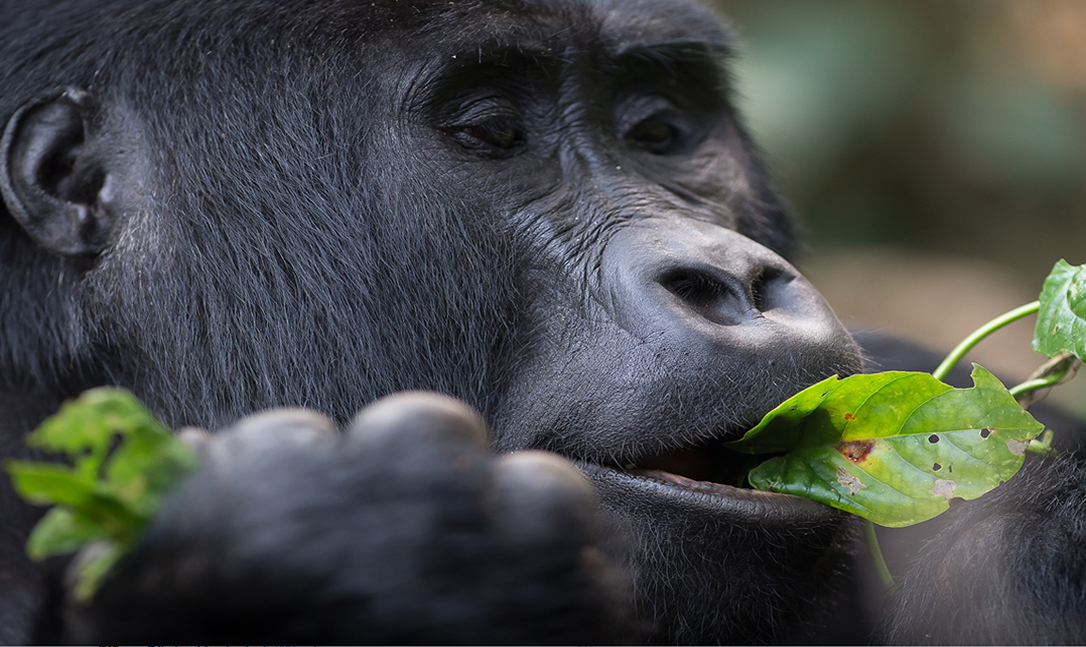
Gorilla permit rescheduling is one of the most searched, and most misunderstood, parts while planning a primate safari in East Africa. Plans change, an epidermic breaks out, a flight gets cancelled, a visa takes longer than expected, a family emergency comes up, or you simply catch a cold three days before your trek. When that happens, the question every traveler asks us at Gorilla Safaris Africa is the same: can I move my gorilla permit to another date, and will it cost me anything?
The honest answer is that Rwanda and Uganda handle this very differently, and knowing the difference before you book can save you hundreds of dollars and a great deal of stress. This guide breaks down exactly how gorilla permit rescheduling in Rwanda vs Uganda works, what it costs, what triggers an automatic rejection, and which country gives you more breathing room if your travel dates are not yet locked in.
What is a gorilla permit?
A gorilla permit refers to a legal official document that acts as ticket that allows you to trek and see mountain gorillas in their natural environment.
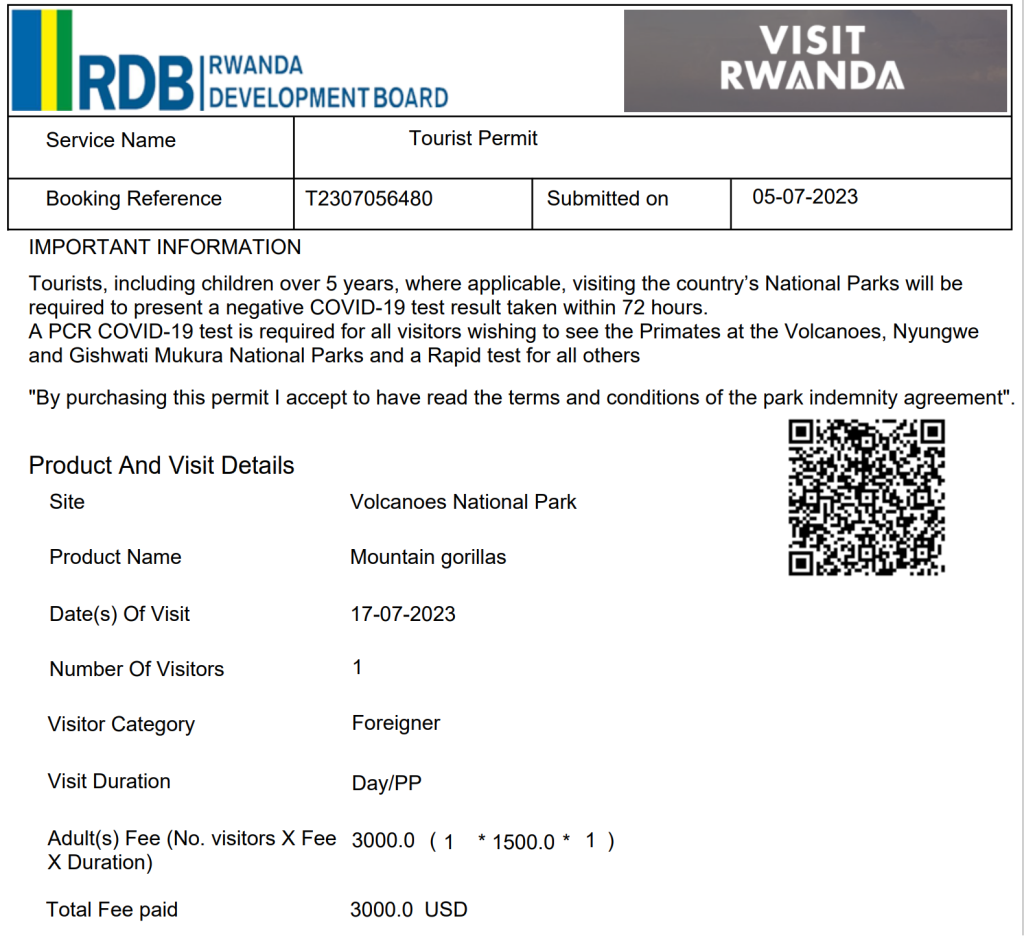
In Rwanda, a gorilla permit costs USD 1500 for non-residents, USD 500 for locals and African citizens, and USD 200 for East African citizens. The price of gorilla permits can reduce a bit during the low season, from November to May.
The price of a gorilla permit in Uganda costs USD 800 for foreign residents, USD 700 for foreign residents, and UGX 300,000 for East African citizens during peak season, which lasts from December to February and June to October.
Gorilla permits can be obtained through booking from trust worthy tour operators who have access with the government office, which is the Uganda Wildlife Authority (UWA) in Uganda and the Rwanda Development Board (RDB) in Rwanda.
Each gorilla permit grants you one-day admission to one of the mountain gorilla families on the date and location mentioned on the permit, with an hour in the presence of the mountain gorillas. This is a regulation designed to safeguard endangered species and fund critical activities such as anti-poaching patrols and community development programs.
Once you have purchased this gorilla permit you must save this trekking date and location. But, sometimes, you may have to postpone or cancel your gorilla trip owing to sudden events such as political instability, work pressures, family emergencies, travel cancellations, health concerns, and others.
The gorilla licenses are not refunded upon cancelation. The best solution is to postpone the trip and reschedule the gorilla permits to a future date.
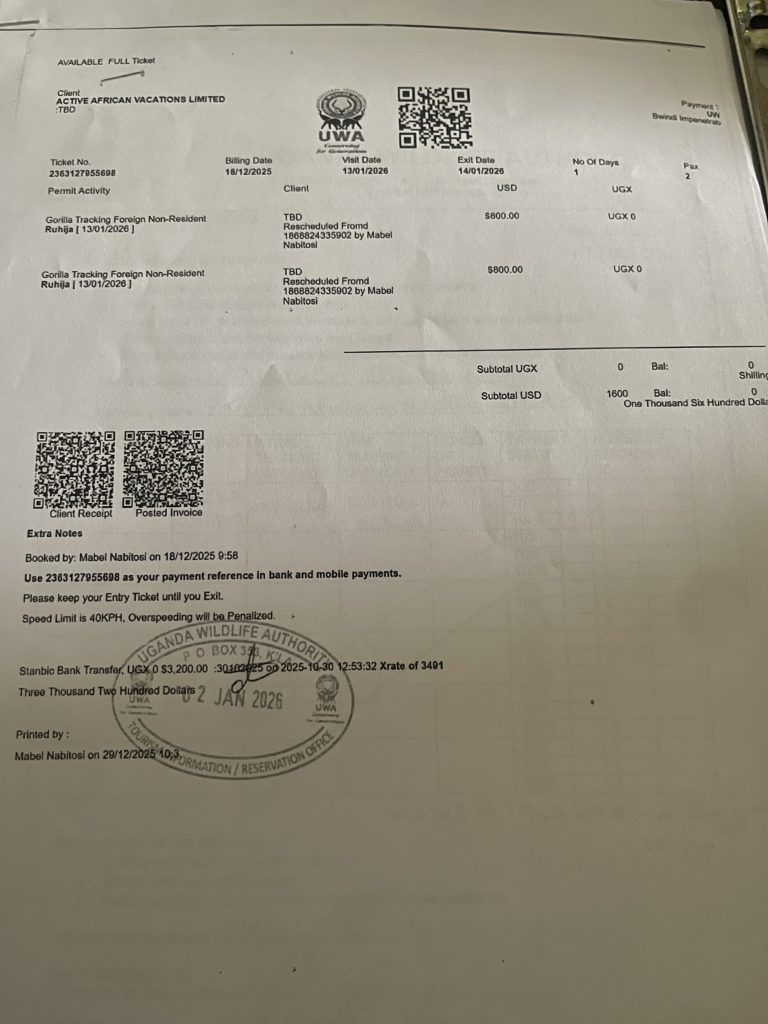
Why Rescheduling Rules Exist in the First Place
Mountain gorilla permits are not ordinary tickets. Both the Rwanda Development Board (RDB) and the Uganda Wildlife Authority (UWA) issue a strictly limited number of permits each day, tied to specific gorilla families, specific dates, and the passport details of a named traveler.
This system exists to protect the gorillas from overcrowding and disease, since they share roughly 98% of human DNA and are highly susceptible to human respiratory illnesses. Because every permit is a finite conservation resource rather than a generic booking, both governments treat changes to it as the exception rather than the rule. That is the backdrop you need to understand before comparing the two systems.
Rwanda Gorilla Permit Rescheduling: How It Actually Works
Rwanda’s Volcanoes National Park releases only 96 permits per day across roughly 12 habituated gorilla families, eight visitors per family. That scarcity is exactly why rescheduling in Rwanda is treated with caution.
The core rule: A request to move your trekking date must be submitted at least 30 days before your original date. Some tour operators with strong RDB relationships can push for exceptions inside that window, but there is no guarantee, and during the June–September and December–February peak seasons, almost every slot is already taken by other travelers, so there may simply be nowhere to move your permit to.
The cost: If you reschedule through a registered tour operator, expect to pay a rescheduling fee of roughly 20% of the permit price. On the standard $1,500 international permit, that works out to around $300. This fee is separate from the $1,500 you already paid, and the original amount is not refunded; it is simply transferred and revalidated for the new date.
What you need to provide: These should include your passport details, original permit number, your preferred new date and a clearly stated reason for the change. If you become ill, Rwanda will usually require you to show this with a medical certificate. RDB will then decide whether to approve or decline the request. Your tour operator is submitting the paperwork on your behalf, but they cannot guarantee the outcome.
Special illness clause: If you arrive in Rwanda and fall sick on the morning of your trek, the policy is more generous than a standard reschedule. You are usually given the choice between attempting the trek the following day or receiving a full refund, since this scenario falls outside the normal 30-day rule.
What does not qualify for a reschedule: permits booked at the discounted low-season rate (the 30% discount available November through May when combined with stays in Akagera or Nyungwe) are generally treated as fixed-date bookings, so check the fine print before assuming flexibility applies.
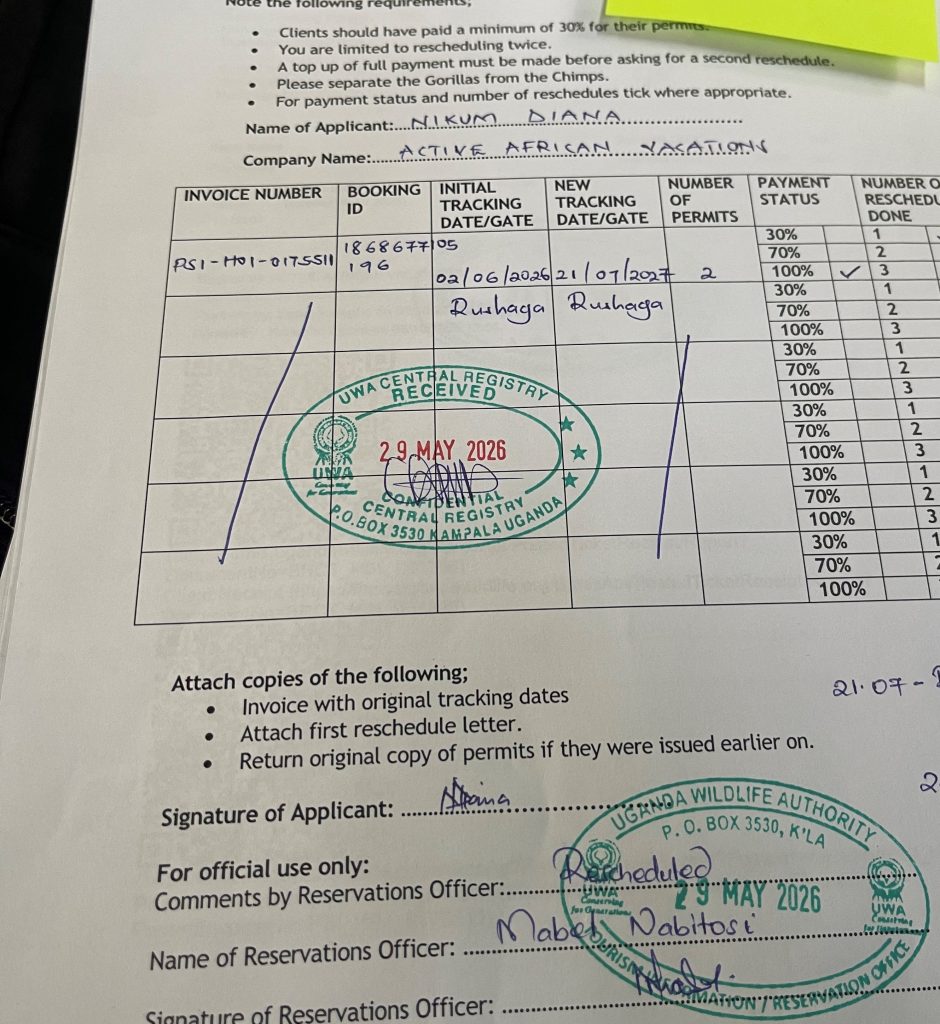
Uganda Gorilla Permit Rescheduling: How It Actually Works
Uganda spreads its gorilla permits across a much larger number of habituated families, around 19 groups across four sectors of Bwindi Impenetrable National Park plus one group in Mgahinga, for a daily total north of 150 permits. That larger inventory gives Uganda noticeably more room to maneuver when a traveler needs a new date.
The core rule: UWA generally allows you to reschedule the permits twice. The first reschedule make sure you do it 2 weeks before the original trekking date, and here its free of charge however if you want to reschedule after the 2 weeks to the trekking date you qualify for a penalty of 25%.
The cost:The price for rescheduling permits is 25 % implying that you will need to pay $ 200 per permit that you are rescheduling once its out of the 2 weeks line to the trekking date.
Illness on the day of trekking: If your self-report symptoms to the park warden before setting off and are not allowed to trek, you may be eligible for a 50% refund of your permit fee, at the warden’s discretion. This is a meaningfully different mechanism from Rwanda’s full-refund-or-retry option, so do not assume the two countries treat illness identically.
What does not qualify for a reschedule: Uganda’s discounted low-season permits (April, May, and November, priced around $600 for non-residents) are explicitly non-reschedulable and non-refundable once purchased. The same caution applies to Rwanda’s discounted permits, so this is one area where both countries align: discount-tier permits trade flexibility for a lower price, and you should only buy them if your dates are already certain.
The Real Difference while rescheduling gorilla permits.
Rescheduling success in both countries is not only about written policy; it is about how many available seats exist on alternative dates.
Rwanda’s smaller daily pool of 96 permits means that even a textbook-perfect, 35-days-in-advance reschedule request can still be turned away simply because every other date in your travel window is already sold out, particularly in July, August, and the Christmas-New Year period.
Uganda’s much larger pool across 19+ gorilla families gives your request more places to land, which is the practical reason Uganda’s rescheduling success rate tends to feel higher to travelers, even though its written notice period is shorter.
This means your real strategy should not be “which country has the friendlier policy on paper,” but “which country has more open inventory near my new preferred date.” A good tour operator checks live availability before submitting any reschedule request, rather than submitting blind and hoping.
Practical Tips for Travelers Booking Through Gorilla Safaris Africa
- Build a buffer into your itinerary. If you are visiting during peak season, treat your trekking date as fixed once booked. Schedule arrival a day or two early so illness, flight delays, or road conditions do not force a last-minute reschedule request you might not win.
- Avoid discount-tier permits unless your dates are 100% certain. Both Rwanda’s low-season 30% discount and Uganda’s April/May/November discount strip out rescheduling flexibility entirely.
- Submit reschedule requests the moment you know you need one. Both RDB and UWA process requests faster, and have more dates to offer, the earlier you ask. Waiting until the 30-day or 14-day deadline is the riskiest possible timing.
- Keep documentation ready:If you have a medical certificate, a notice of airline cancellation or travel advisory issued by the government, you will be in a stronger position in both countries. This is especially so in Uganda where you are required to submit a written letter giving your reasons.
- Combine countries if your dates are flexible. Some travelers cross from Rwanda into Uganda (or vice versa) when their preferred Volcanoes National Park date is unavailable, since both parks track the same mountain gorilla population across the shared Virunga landscape.