

Why Hire a Porter for Gorilla Trekking
There is a moment on almost every gorilla trekwhere the trail stops being a trail. The path narrows into a tunnel of vines, the ground turns to red mud that grabs at your boots, and the slope in front of you looks less like a hiking route. This usually happens somewhere between forty minutes and two hours into the hike, long after the guide has warned you that Bwindi means “impenetrable” for a reason.
It’s at exactly this point that most first-time trekkers understand, a little too late, why the ranger at the briefing kept repeating one piece of advice: Why You Should Hire a Porter for Your Gorilla Trekking Experience.
We say this to every guest who books through Gorilla Safaris Africa, and we’ll say it again here, because it’s the one piece of pre-trek advice that almost nobody regrets taking and quite a few people regret ignoring
What a Porter Actually Does on a Gorilla Trek
A porter is a local guide’s assistant, assigned to you individually for the day, whose job is to make the physical part of the trek manageable. That sounds simple, but it covers more ground than most travelers expect:
- Carrying your daypack: They provide assistance in lifting your day pack that bears camera gear, rain jacket, water, snacks, and anything else you’d normally sling over your shoulders and regret by hour two.
- Physical support on the climbs: Porters give in a firm hand on the steep sections, a shoulder to lean on when the mud gets slick, and someone pulling or steadying you where the incline gets serious.
- Clearing a path through using a machete where the undergrowth has swallowed the trail since the last group came through.
- Reading the terrain, Porters walk these hills daily and know which roots hold weight and which patches of ground are actually a shin-deep bog in disguise.
- Basic English and local knowledge most porters speak workable English and can tell you about the plants, the village life at the forest edge, and the wildlife you’re passing, which the guide up front doesn’t always have time to cover.
Why You Should Hire a Porter for Your Gorilla Trekking Experience: For travelers who need more than that, porters can also carry an assisted chair a simple stretcher-style seat for guests with limited mobility, older travelers. It can be anyone recovering from an injury who still wants to reach the gorillas. It’s a service that quietly makes gorilla trekking possible for people who assumed it wasn’t an option for them.
Bwindi and Volcanoes trails .
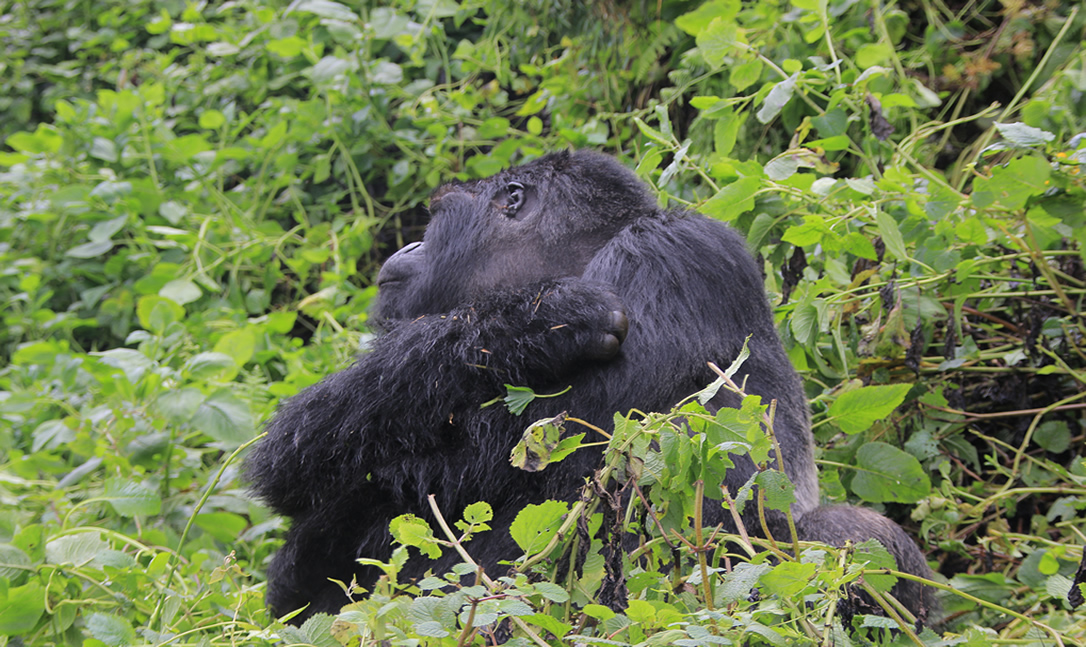
Photos of gorilla trekking tend to show the payoff a silverback in a clearing, sunlight through the canopy and almost never the hour beforehand. That hour is the part a porter is built for.
Bwindi Impenetrable National Park sits at altitude, much of it above 2,000 meters, and the terrain inside is genuinely steep rainforest: no graded paths, no railings, no shortcuts. Rwanda’s Volcanoes National Park trades dense forest for volcanic slopes that look gentler from a distance and are not, especially after rain. In both parks, the trek can run anywhere from thirty minutes to six hours, depending entirely on where the gorilla family happens to be that morning, and nobody knows the answer until the trackers radio it in.
None of this is disclosed to scare anyone off. Thousands of trekkers in their sixties, seventies, and beyond complete the hike successfully every year. The point is narrower: this is not a groomed nature walk, and the gap between “manageable with help” and “genuinely exhausting” often comes down to whether someone is carrying your bag and steadying you on the descent.
What It Costs, and Why That Number Is Almost Beside the Point
A porter in Bwindi or Volcanoes National Park typically costs between $15 and $20 for the day. Compare that to the permit itself $800 in Uganda, $1,500 in Rwanda and it becomes clear that the porter fee is a rounding error on a trip most people save for over months, if not years.
Tour operators frequently leave the porter fee off their initial quote, since it’s classified as optional. We’d rather flag it upfront: budget $20, pay it in cash on the morning of your trek, and treat it as one of the smallest and most consequential line items in your entire safari.
Hiring a porter is part ofconservation success.
Did you know that when you hire a porter for gorilla trekking you are contributing to conservation: Many of Bwindi’s porters are former poachers. Through community programs that took root after the 1990s including the Bwindi Reformed Poachers’ Association, a group that has operated since 1992 men who once set snares in this same forest for bushmeat now carry visitors’ bags through it instead. Local rangers describe it plainly: a porter earning a wage from tourists has no reason to go back into the forest to trap wildlife. The income replaces the incentive.
Some porters are Batwa, the forest’s original inhabitants, displaced when Bwindi became a protected park in 1991 and now rebuilding a livelihood around the same land in a different form. Others are simply local residents often women for whom porter work is one of the few steady income sources available in a farming community bordering a national park.
When you hire a porter, the $20 doesn’t just buy you an easier hike. It funds a direct, working alternative to poaching, in the exact forest that shelters roughly half of the fewer than 800 mountain gorillas left on the planet. Few other tourism transactions anywhere in the world connect that directly to conservation.
Who Should Never Skip hiring a porter while on their trekking safari.
- Anyone over 60, regardless of general fitness, since altitude and unpredictable terrain affect people differently than they expect.
- Travelers with knee, hip, or back issues, even mild or well-managed ones.
- Photographers carrying camera bodies, extra lenses, and tripods gear that turns into dead weight on a muddy incline.
- Anyone trekking in the rainy season (roughly March–May and September–November), when trails turn to slick clay and a steadying hand stops being optional.
- Parents trekking with teenagers (the minimum age for gorilla trekking is 15 across Uganda, Rwanda, and the DRC) who may tire faster than expected on a multi-hour hike.
- First-time trekkers of any age, simply because there’s no way to know your reaction to Bwindi’s terrain and altitude until you’re already on it.
How to Actually Hire One
Unlike your gorilla permit, which needs booking three to twelve months ahead, a porter is arranged on the spot. At the morning briefing, park staff or your guide will ask if anyone wants a porter, and you can request one there no advance paperwork required. If you’d rather not decide in the moment, mention it to your tour operator when booking and they’ll flag it for the ranger station in advance.
A few practical notes:
- Pay in cash, in small notes if you have them (Ugandan shillings, Rwandan francs, or US dollars are all generally accepted, but check with your operator).
- Tip separately from the base fee if your porter went beyond the basics carrying you, clearing an unusually rough section, or simply working harder than the job strictly required.
- One porter per trekker is standard; you don’t need to share, and sharing isn’t recommended if you’re each carrying separate bags.
A Quick Honest Answer to “Do I Really Need One?”
Why You Should Hire a Porter for Your Gorilla Trekking Experience: If you’re young, fit, traveling light, and trekking in the dry season with a gorilla family known to be close to the trailhead you could probably manage without one.
Even then, most operators, including us, will still tell you to hire a porter anyway, because there is no way to predict which gorilla family you’ll be assigned or how far they’ve moved overnight. You could be looking at a thirty-minute stroll or a four-hour uphill slog, and you won’t know which until you’re already on the trail.
For everyone else, the porter isn’t a luxury add-on. It’s the difference between a trek you remember for the gorillas and a trek you remember for how hard the hike back down was.
Frequently Asked Questions
Is hiring a porter mandatory for gorilla trekking? No. It’s optional in Uganda, Rwanda, and the DRC. Park authorities and guides recommend it strongly, but you won’t be turned away if you decline.
How much does a gorilla trekking porter cost? Typically $15–$20 per person per trek, paid directly and in cash on the morning of your hike. This is separate from your gorilla permit and not usually included in tour package pricing.
Can a porter carry me if I can’t manage the hike? Yes. Porters can arrange an assisted chair (a stretcher-style seat carried by a small team) for elderly travelers, pregnant women, or anyone with limited mobility, at an additional cost agreed with the ranger station in advance.
Do I tip the porter separately? Yes, a tip beyond the base fee is customary and appreciated, particularly if the terrain was difficult or your porter provided extra physical support.
Where does the porter money actually go?Directly to a local community member, many of whom are Batwa residents or former poachers now earning a legal livelihood connected to the park. It’s one of the more direct forms of community-based tourism income in the region.
Do I need to book a porter in advance?No. Porters are arranged on the morning of your trek at the briefing point, unlike gorilla permits, which must be secured months ahead.
Planning a gorilla trek in Bwindi or Volcanoes National Park? Gorilla Safaris Africa can arrange your permit, transport, and porter in one booking get in touch and we’ll build the itinerary. Contact us today at + 256 701 819 223 or email us today at info@gorillasafarisafrica.com