
Tree Climbing Lions in Ishasha Sector.
Deep in the southernmost corner lies Queen Elizabeth National Park, where the savanna tilts toward the Rwenzori horizon, lions do something that lions simply are not supposed to do they climb trees, and they stay there.
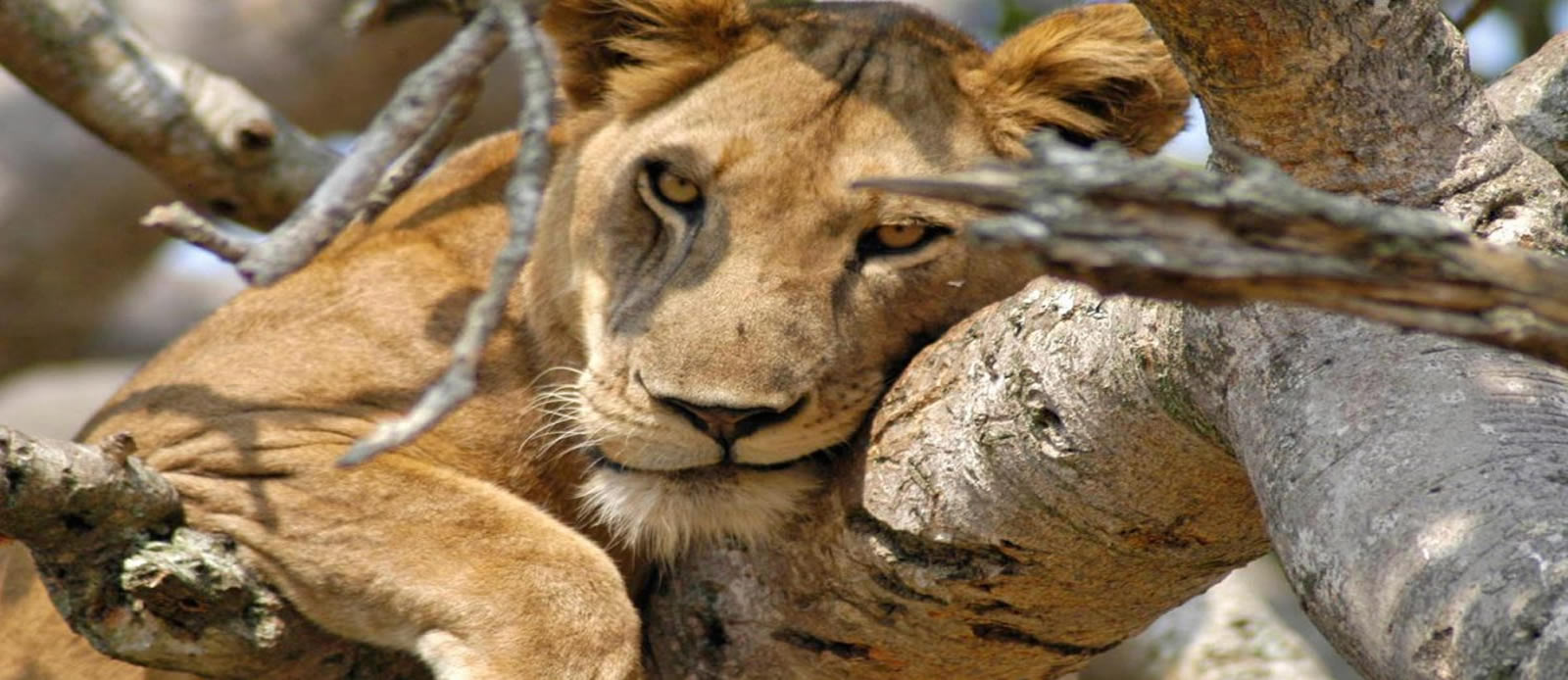
Lion resting in a fig tree at Ishasha, a behaviour rarely documented anywhere else in Africa. There is a particular quality to the silence in Ishasha just before dawn the kind that seems borrowed from another era, before roads and noise and the relentless forward march of things. The grass lies flat and silver. The fig trees stand enormous and still. And somewhere in their upper branches, if the morning is kind to you, a pair of amber eyes opens and stares down.
Ishasha sector is the southernmost enclave of Queen Elizabeth National Park, pressed against the border of the Democratic Republic of Congo in western Uganda. It covers roughly 300 square kilometres of open savanna, acacia scrub, and woodland landscape that, at first glance, looks much like the classic East African safari country most travellers picture. But Ishasha is not most places. Ishasha is where the lions go up. This guide offers to you a perfect highlight about Tree climbing lions in Ishasha sector.
Why These Lions Climb and Why Nobody Fully Knows?
Tree-climbing lions are documented at only two sites on the African continent with any regularity: Ishasha, and the shores of Lake Manyara in Tanzania. A handful of individuals have been observed doing it elsewhere, but nowhere does the behaviour appear to be as deeply embedded in the culture of an entire pride as it is in Ishasha.
The dominant theory is thermal regulation. Ishasha’s savanna floor bakes under the equatorial sun, and the flat-topped fig trees primarily Ficus natalensis, the Natal fig offer a raised platform with reliable afternoon breeze. Up in the canopy, flies and biting insects are fewer, the heat is marginally more bearable, and a lion’s view of approaching prey extends considerably further across the plain below.
“There is no single explanation that satisfies. Perhaps the lions climbed once, found the world looked different from up there, and simply never stopped.”
A competing theory involves the tsetse fly, which clusters at ground level and inflicts particular misery during the late dry season. Some researchers believe the lions learned, over generations, to escape the worst of it by retreating to the branches. Others point to prey-spotting advantage a lioness at ten metres elevation can see across the Ishasha plain in a way that no amount of grass-crouching allows. The honest answer is that no single theory fully satisfies, and the behaviour may be a convergence of multiple pressures, selected for and then culturally transmitted through the pride over decades.
What is certain is this: the young learn it from the old, and the prides of Ishasha have been spotted in the canopy for as long as rangers have been keeping records.
The Best Spots to Find Them: Knowing Where to Look.
Tree climbing lions in Ishasha can be spotted in the trees. The trees themselves are the key. Ishasha’s fig trees grow primarily along two main circuits within the sector, and experienced guides know each one by name, by character, and by historical record. The most celebrated are the large figs that line the floodplain near the Ishasha River, a stretch of riparian woodland where generations of lions have rested on the same boughs their grandmothers used before them.
On a good morning and Ishasha rewards those who start before breakfast you may find an entire pride distributed through a single tree with the casual arrangement of scattered cushions. An adult male, mane wind-ruffled, draped over a branch at eleven metres. Two sub-adults twisted into angles that would challenge a yoga instructor. A cub peering with enormous curiosity at the vehicle below, far too young to grasp that this is, by the standards of the wider lion world, deeply unusual behaviour.
Where to search first
Ishasha River floodplain: most consistent sightings; large fig corridors along the bank hold lions year-round.
Nyungwe River crossing (secondary circuit favoured in the dry season when grass is short and visibility is highest.
Northern circuit figs older, broader canopies that the dominant prides have used for at least two decades according to ranger records.
Shaded gullies near the Congo border (a darker, quieter zone where smaller sub-prides rest away from tourist traffic.
Best time to visit Ishasha.
Ishasha is accessible year-round but the experience changes dramatically with the season. The dry seasons June through August and December through February offer the clearest conditions. Grass burns back, the laterite roads firm up, and lions have less cover on the ground, which makes the trees an even more appealing option. These months bring the highest concentration of wildlife and the most reliable game viewing across the whole of Queen Elizabeth National Park.
The long rains of March to May turn parts of the Ishasha circuit into deep red mud, and certain tracks become impassable without a high-clearance 4×4. That said, the green season has its own rewards: the landscape transforms into something almost impossibly lush, birding reaches its peak, and the lions, bathed in yellow light against thunderhead skies, deliver some of the most dramatic photographic conditions in all of East Africa.
Early morning and late afternoon are the productive windows for finding lions in the trees. The middle hours are hot enough that even arboreal lions tend to sleep deeply and invisibly. Plan your game drives to be out by 6:30 am and again from 4:00 pm, and work the known fig corridors methodically. Patience, as ever, is the chief skill required.
Getting to Ishasha: The Journey Is Part of It
Ishasha lies approximately 480 kilometres southwest of Kampala, a drive of roughly 6 to eight hours depending on road conditions and stops. The route passes through Fort Portal, skirts the Kibale forest,and descends through Kasese toward the southern park gate a journey that is itself a rolling documentary of western Uganda’s extraordinary landscape.
Many visitors combine Ishasha with the rest of Queen Elizabeth National Park, entering from the north at Kasese or Mweya and driving south through the park over two or three days. This allows encounters with the famous Kasenyi pride and the channel’s boat safaris before the landscape opens into the Ishasha savanna.
Charter flights from Entebbe or Kampala can reach the Ishasha airstrip, making it possible to reach the sector in under two hours and spend two focused nights on the tree-climbing lions before flying onward. Several lodges operate within or immediately adjacent to the sector and can arrange transfers.
Practical Tips for the Best Experience
Rise before the sun: At exactly 6:30 am departures are standard. The first hour of light is when lions are active and repositioning in the trees before the heat sets in.
Work with a knowledgeable guide: Rangers who have tracked these prides for years know individual animals by sight. Their knowledge is irreplaceable and cannot be replicated by any app.
Bring a long lens: A 300–500mm lens allows respectful distance while filling the frame. Do not ask guides to push closer to trees where lions are resting it disrupts their behaviour.
Stay two nights minimum: One morning gives you a single chance. Two nights give you three drives and a far greater likelihood of finding lions above the tree line.
Beyond the Lions: What Else Awaits in Ishasha
Ishasha is not only about lions, though it is understandable if the lions consume all available attention. The sector holds large herds of Uganda kob, topi, buffalo, and African elephants that move across the floodplain in the afternoons. The bird list is remarkable grey crowned cranes, African fish eagles, martial eagles, and more than 600 recorded species across the wider park make it one of the most bio diverse corners on the continent.
The remoteness is itself part of the appeal. Ishasha receives far fewer visitors than Mweya or the Kasenyi plains, and there are mornings when a single vehicle occupies the entire floodplain circuit. That quality of solitude of being genuinely alone with something ancient and wild is increasingly rare in African conservation areas, and Ishasha guards it with distinction.
Why Ishasha Stays with You.
Travel accumulates into a long blur of airports and menus and forgettable afternoons. The things that remain are specific: a sound, a smell, a moment when the world arranged itself into something true. Ishasha does this. A lion in a tree is objectively strange it belongs, at some cellular level, to a different Africa than the one we carry in our heads.
And precisely because it is strange, it lodges. You come home, and weeks later, in a morning meeting or a supermarket queue, you find yourself suddenly back under a fig tree in the early Ugandan light, looking up at something that is looking back down at you.
There are many reasons to go to Uganda. The mountain gorillas of Bwindi are justifiably famous. The chimpanzee forests of Kibale are extraordinary. But Ishasha quiet, unhurried, peculiar in the best possible sense offers something that those places do not: the specific sensation of watching a lion be wrong, by every rule of lions, and be magnificently right.
Company
Gorilla Safaris Africa is one of the leading experts to trust while you are seeking for unforgettable and gorillas safaris with in Africa.
Features
Most Recent Posts
- All Post
- Combined Safaris
- East Africa
- Gorillas
- Luxury Safaris
- Primates Safaris
- Wildlife