
Akagera National Park
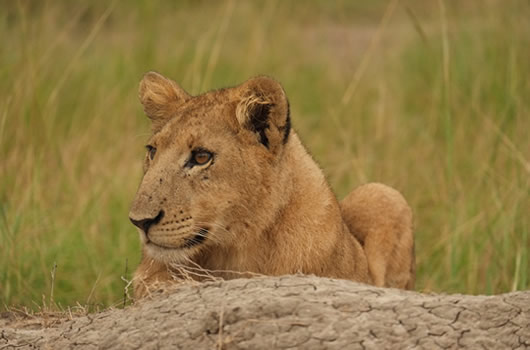
There are places that ask nothing of you on arrival where the road flattens, the sky opens, and the landscape simply declares itself. Akagera National Park is one of those places. You cross the park boundary and the savannah rolls away in every direction, broken by acacia woodland and the silver glint of distant lakes, and somewhere out there in that immensity a lion is moving through the long grass with the complete indifference of an animal that has only recently remembered it owns this ground.
Because that is, in a very literal sense, what happened here. The lions of Akagera were gone. Poaching, habitat pressure, the catastrophic disruption of the 1994 genocide and its aftermath by the early 2000s, the park had lost not only its lions but much of its large mammal population, and had been reduced to less than a third of its original size by encroachment from displaced communities returning home after the genocide. What remained was a landscape with a memory of what it had been and very little of what it once contained.
What followed is one of the most instructive conservation stories in Africa, and the reason Akagera today is not only intact but expanding. Through a partnership between the Rwanda Development Board and African Parks, established in 2010, the park was restocked, its boundaries secured, its communities engaged, and its ecological integrity systematically rebuilt. Lions were reintroduced from South Africa in 2015.
Black rhinos, locally extinct for decades, were reintroduced in 2017 and again in 2019. The elephant population, which had survived in reduced numbers, has grown steadily. The result is the only Big Five destination in Rwanda and, more than that, a functioning, biodiverse savannah ecosystem that exists because people chose to rebuild it and have not stopped working to sustain it.
Akagera demands to be understood in that context. It is not merely a beautiful park in a beautiful country. It is an argument, made in landscape and in wildlife, about what is possible when conservation is taken seriously.
Location of Akagera National Park
Akagera National Park lies in the Eastern Province of Rwanda, along the country’s border with Tanzania. It covers approximately 1,122 square kilometres of savannah, woodland, wetland, and lake systems the largest protected wetland in central Africa stretched along the Akagera River, from which the park takes its name. The park’s eastern boundary follows the river and its associated chain of lakes; the western boundary runs along a ridge of low hills that catches the morning cloud before it burns off to reveal the plains below.
The park sits roughly 100 kilometres from Kigali, making it the most accessible of Rwanda’s national parks from the capital a distance that can be covered in two to two and a half hours along a road that improves steadily as you leave the city behind. The journey east is itself a lesson in Rwandan geography: the dramatic green hills of the central plateau give way to a more open, drier landscape as you descend toward the Akagera valley, the temperature rising slightly, the vegetation becoming more sparse, the sky growing wider.
The name Akagera refers to the river that defines the park’s eastern edge a waterway that rises in Burundi, crosses Rwanda, and empties eventually into Lake Victoria. Along its course through the park it expands into a series of lakes Ihema, Shakani, Hago, Rwanyakizinga, and others that together form the heart of the park’s wetland system and the ecological foundation of everything that lives here. The lakes are not incidental to Akagera’s wildlife; they are its engine, drawing animals to water, sustaining the papyrus marshes that shelter the shoebill stork, and providing the navigable surface for boat safaris that offer a perspective on the landscape available nowhere else.
The park is divided informally into two zones by visiting patterns if not by any physical feature: the southern sector, which is more accessible and concentrated in its game viewing, and the northern sector, which is wilder, less visited, and rewards the traveller willing to go further with a quality of solitude that has become genuinely rare in East African wildlife tourism.
Where Is Queen Elizabeth National Park?
Queen Elizabeth National Park lies in western Uganda along the floor of the Great Rift Valley, roughly 400 kilometres from Kampala. It is bounded by Lake Edward and the Democratic Republic of Congo to the west, the Kyambura Gorge and Kalinzu Forest Reserve to the east, the Rwenzori Mountains to the north, and the Kigezi Wildlife Reserve to the south. This extraordinary geographic position nestled between one of Africa’s great mountain ranges and one of its deepest lakes, straddling the equatorial line gives the park an ecological complexity that few protected areas anywhere on the continent can match.
Originally gazetted as Kazinga National Park in 1952, the park was renamed in 1954 following a visit by Queen Elizabeth II. Today it sits within a broader constellation of contiguous protected areas including Kibale National Parkto the north, Kigezi Wildlife Reserve to the south, and the vast Virunga National Park across the border in the DRC making it part of one of the largest transboundary conservation landscapes in East Africa.
The park divides naturally into distinct sectors, each with its own character. The Mweya sector in the north, built around the iconic peninsula where the Kazinga Channel meets Lake Edward, is the park’s heartland and where most visitors base themselves. The Ishasha sectorin the far south is remote, atmospheric, and famous for something found almost nowhere else on earth. The Kyambura Gorge cuts through the eastern edge like a green wound in the savannah, harbouring a small and haunting community of chimpanzees. Understanding which sector you are in — and why — transforms what might otherwise feel like a large, undifferentiated wilderness into a series of deeply distinct experiences.
Activities at Queen Elizabeth National Park
Game Drives
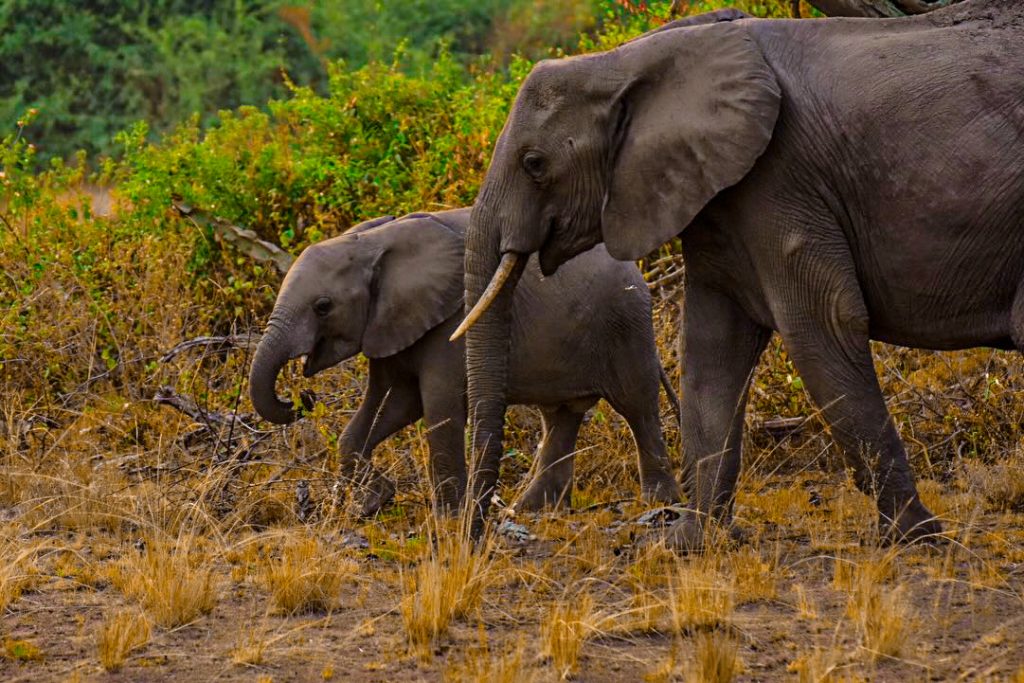
The savannah game drive remains the park’s most accessible and consistently rewarding activity. The Kasenyi Plains circuit in the northeast provides the most reliable big game viewing — this is lion country, elephant country, and the best place in the park for large concentrations of Uganda kob. The Queen’s Mile circuit around the Mweya Peninsula offers excellent close-up encounters with hippos and buffalo along the channel shore. Early morning drives, beginning at first light, offer the best conditions: the light is extraordinary, the animals are active, and the temperature is manageable. Late afternoon drives, from around 4 p.m. until dusk, are equally productive and have the additional benefit of spectacular sunsets over Lake Edward.
For the Ishasha sector, the game drive is a dedicated expedition into the remote southern reaches of the park. The fig trees here particularly the enormous specimens along the Ntungwe and Ishasha rivers are where the tree-climbing lions are most likely to be found. The drive to and through Ishasha requires commitment, both in terms of distance and time, but travellers who make the effort consistently describe it as a transformative experience.
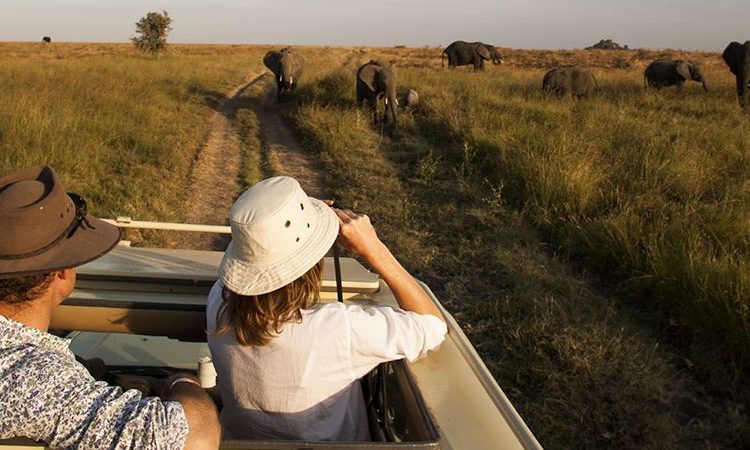
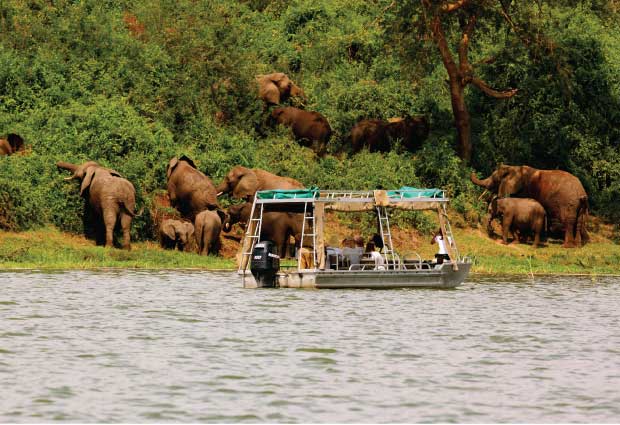
Elizabeth National Park cite as the highlight of their visit, and the consistency of that judgement reflects the consistency of the experience itself.
The channel’s shores are lined with buffalo, elephant, and warthog coming down to drink; its waters support multiple pods of hippos and a resident Nile crocodile population; its banks are alive with birds at all hours. Launched from the Mweya Peninsula, cruises operate at 9 a.m., 11 a.m., 3 p.m., and 5 p.m.
The two-hour morning cruise takes advantage of the best light and the highest animal activity. The late afternoon cruise offers the drama of hippos becoming increasingly.
The channel is approximately two to three kilometres wide at its broadest point and was formed by tectonic activity millions of years ago. From the water, you see the park from an angle unavailable from any vehicle, and the cumulative impact of the wildlife — hundreds of hippos, dozens of crocodiles, herds of buffalo drinking ten metres from the boat
Kazinga Channel Boat Cruise
The Kazinga Channel cruise is the single activity that most visitors to Queen Elizabeth National Park cite as the highlight of their visit, and the consistency of that judgement reflects the consistency of the experience itself. The channel’s shores are lined with buffalo, elephant, and warthog coming down to drink; its waters support multiple pods of hippos and a resident Nile crocodile population; its banks are alive with birds at all hours. Launched from the Mweya Peninsula, cruises operate at 9 a.m., 11 a.m., 3 p.m., and 5 p.m. The two-hour morning cruise takes advantage of the best light and the highest animal activity. The late afternoon cruise offers the drama of hippos becoming increasingly.
The channel is approximately two to three kilometres wide at its broadest point and was formed by tectonic activity millions of years ago. From the water, you see the park from an angle unavailable from any vehicle, and the cumulative impact of the wildlife — hundreds of hippos, dozens of crocodiles, herds of buffalo drinking ten metres from the boat
Chimpanzee Trekking in Kyambura Gorge
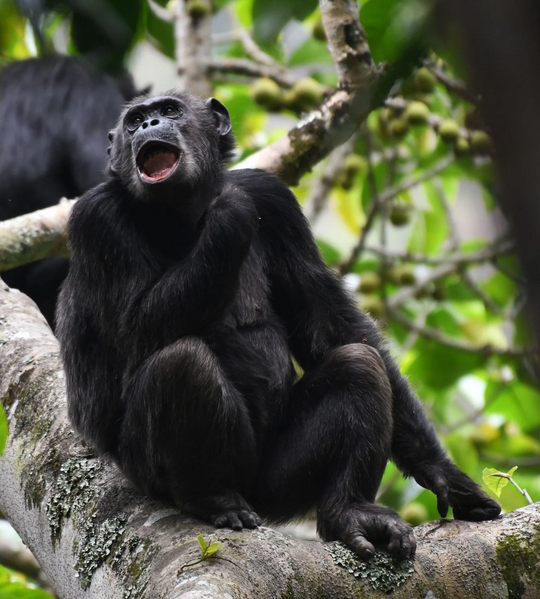
The descent into Kyambura Gorge is one of the stranger transitions available to a safari traveler. You leave your vehicle on the open savannah, walk to the gorge rim, and within a few minutes of descent are enclosed in dense rain forest.
The chimpanzees are habituated through years of patient work by researchers and rangers move through the forest with the authority of animals in their own habitat. Encounters are unpredictable in the way that all genuinely wild encounters are: some days the chimps are visible and relatively close, engaged in the complex social business of a chimpanzee morning; other days they are deep in the forest and you glimpse them through the canopy, hear them calling, find the nests they abandoned at dawn.
Either way, the gorge itself is extraordinary, the fig trees, the bird life, the river below, and the surreal awareness that you are in the middle of a rain forest inside a savannah park.
For visitors who want a more extensive chimpanzee experience, Maramagambo Forest and the nearby Kalinzu Forest Reserve offer additional trekking opportunities with different habitats and resident primate communities.
Lion Tracking
One of the more unusual activities available in the park is the opportunity to join Uganda Carnivore Program researchers as they use radio-collar telemetry to locate and monitor the park’s lion prides.
This is not a conventional safari activity: it is a behind-the-scenes look at the science and human dedication that underpin lion conservation in Uganda, conducted by researchers who know individual animals by name and can read their behaviour with an intimacy that takes years to acquire.
The experience of tracking a pride using signal data, approaching on foot with researchers who can interpret every movement, and spending time in the presence of lions with people who have dedicated their professional lives to understanding them is genuinely unlike anything a standard game drive delivers.
Katwe Salt Lake Visit
Lake Katwe, just north of the Mweya Peninsula, has been a source of rock salt for the surrounding communities for centuries — possibly millennia. The lake is ancient, alkaline, and powerfully sulphurous, and the traditional salt-harvesting operations that continue on its shores represent one of the most enduring and underappreciated intersections of human culture and natural landscape in Uganda. A visit to the Katwe salt works, guided by community members who explain the extraction process and the economic significance of the lake, is a counterpoint to the wildlife experiences that gives the park visit a richer human dimension.
Cultural Village Visits
The communities surrounding Queen Elizabeth National Parkbelong primarily to the Banyaruguru, Basongora, and Bakiga peoples, and community tourism visits organised through the Uganda Wildlife Authority offer genuine engagement with cultures that have coexisted with this landscape and its wildlife across generations. Visits to Kikorongo and Katwe villages provide context for understanding how local communities navigate the complex relationship between conservation and livelihood, and the revenue from these visits contributes directly to community programmes that make conservation economically viable at a local level.
Crater Lake Walks and Drives
The volcanic crater lakes of Queen Elizabeth National Park are among the most visually dramatic landscapes in Uganda. Formed by ancient volcanic explosions, these perfectly circular basins are scattered across the park’s northern and eastern sectors, some filled with water that ranges from deep blue to emerald green to a striking reddish-brown depending on the mineral content and algae communities present. The 27-kilometre drive along the crater circuit between Kabatoro Gate and the Queen’s Pavilion passes through terrain unlike anything else in the park — a rolling, pockmarked landscape where each hilltop offers a view across several craters simultaneously. Guided walks to and around individual crater rims offer close-up perspectives on both the geology and the wildlife that uses the crater lakes as water sources.
Best Time to Visit Queen Elizabeth National Park
Queen Elizabeth National Park rewards visitors at any time of year, but the two dry seasons represent the most reliably rewarding periods for wildlife viewing.
Dry Season: June to September and December to February
The June-to-September dry season is the park’s peak period and, for most visitors, the most satisfying time to be here. Vegetation thins, water sources concentrate animals along predictable routes — particularly the Kazinga Channel — and the Kasenyi Plains deliver their most reliable lion and elephant viewing. Roads throughout the park are in good condition, boat cruises operate without weather-related disruption, and the clear skies offer the best chances of Rwenzori Mountain views, which clouds obscure for much of the rest of the year. This period coincides with European and North American summer holidays, so accommodation at popular lodges should be booked well in advance.
December and January provide an excellent dry-season alternative. Visitor numbers are lower than during the June-September peak, accommodation rates at some properties are reduced, and wildlife viewing conditions are comparable.
Wet Season: March to May and September to November
The long rains of March to May can make some of the park’s tracks challenging for vehicles that are not properly equipped, and afternoon game drives can be interrupted by heavy downpours. However, the wet season brings a landscape that is genuinely beautiful — lush, saturated, and alive with the green exuberance of the tropics after rain — and it delivers its own wildlife rewards. Migratory bird species arrive in significant numbers, making the October-November period particularly spectacular for birders when resident and migratory species overlap. Newborn animals appear frequently across the wet season months, and the reduced tourist numbers mean that wildlife encounters have an intimacy that the peak season sometimes lacks.
For chimpanzee trekking in Kyambura Gorge, the wet season actually offers advantages: the forest is more active, the vegetation is full and rich, and the chimps tend to be more vocal and visible in the lower canopy.
How to Get to Queen Elizabeth National Park
By Chartered Flight
Aerolink Uganda and other regional charter operators offer scheduled and chartered flights between Entebbe International Airport and Mweya Airstrip, a journey of approximately one hour.
The aerial approach over the Rift Valley and the crater lakes, with the Rwenzori Mountains to the north and Lake Edward shimmering below, is spectacular. From Mweya Airstrip, the lodge or a park vehicle will collect you for the short drive to the peninsula.
For travellers combining Queen Elizabeth with Bwindi Impenetrable Forest, charter flights allow the same journey that would take a full day by road to be accomplished in thirty minutes.
By Road from Kampala
The standard route is by road from Kampala, a journey of approximately 400 kilometres along the Kampala–Masaka–Mbarara–Kasese highway.
In good conditions, the drive takes between five and six hours and passes through some of Uganda’s finest scenery: the terraced hills of Masaka district, the tea estates above Mbarara, the dramatic escarpment drop into the Rift Valley, and as you approach the park the first sightings of Rwenzori peaks above the horizon.
The main entry point is Katunguru, where the highway crosses the Kazinga Channel on a bridge that offers your first view of the waterway and its hippos, and where the park gate is clearly signed.
Essential Tips for Visiting Queen Elizabeth National Park
- Book the Kazinga Channel cruise in advance. The morning cruise is consistently the most popular and regularly fills during peak season. Ask your lodge to book it at the time of accommodation reservation, not on arrival.
- Allocate enough time. The conventional wisdom is that three to four days allows you to cover the Mweya sector highlights — game drive, boat cruise, and a crater lake excursion. To add Kyambura Gorge chimpanzee trekking and the Ishasha tree-climbing lions, plan for five to seven days. The park is large and its sectors are genuinely distant from one another; rushing between them means doing justice to none.
- Hire a Uganda Wildlife Authority guide. Even experienced self-drive safari travellers report that UWA guides add dimensions to the Queen Elizabeth experience that no amount of guidebook reading can replicate. They know where specific lion prides have been seen, they can read animal behaviour in ways that require years of accumulated observation, and their knowledge of the park’s history, ecology, and cultural context gives the experience a depth that is otherwise inaccessible.
- Start game drives before sunrise. The Kasenyi Plains in particular reward travellers who are in position before dawn. The light in the first hour after sunrise is extraordinary, the lions are active, and the sense of having the landscape to yourself — before the midday heat and other vehicles arrive — is one of the finest feelings a safari can deliver.
- Bring a quality pair of binoculars. With 610 bird species in residence, binoculars are not optional equipment — they are the difference between a pleasant wildlife experience and a transformative one. The channel cruise in particular rewards observers who can pick out distant birds on the far bank or track a fish eagle from a kilometre away.
- Dress for equatorial weather. Queen Elizabeth straddles the equator and the heat during dry-season middays is significant, especially on open savannah game drives. Light, long-sleeved clothing in neutral colours protects against both sun and insects. A light layer for early morning boat cruises and game drives, when river mist can make the first hour genuinely cool, is worth packing.
- Carry cash. Card facilities are unreliable in Kasese and essentially unavailable within the park. Ugandan shillings are necessary for park fees paid at the gate, guide tips, and community visit contributions.
- Respect the Kazinga Channel hippos. Hippos that have left the water — particularly at night or in the early morning — are unpredictable and potentially dangerous. This applies to walking anywhere near the channel shore without a ranger and, particularly, to camping at locations near the water. Hippos are responsible for more human fatalities in Africa than any other large mammal. Their apparent placidity on a boat cruise should not be mistaken for gentleness.
Mweya Safari Lodge :
Positioned on the tip of the Mweya Peninsula where Lake Edward, Lake George, and the Kazinga Channel converge, Mweya Safari Lodge is the park’s most iconic address. The views from the lodge are extraordinary rolling hills, open water, and the channel below, with buffalo and elephant visible from the terrace most mornings.
Kyambura Gorge Lodge — Built on the escarpment overlooking the gorge that gives it its name, this solar-powered eco-lodge is one of Uganda’s finest examples of luxury accommodation done with genuine environmental conscience. The cottages are elegantly designed with views across the plains to the Rwenzori Mountains, and the food is outstanding.
Ishasha Wilderness Camp — For travellers making the journey to the southern sector in pursuit of tree-climbing lions, Ishasha Wilderness Camp provides accommodation that is properly immersive. Set beside the Ntungwe River in the remote Ishasha region, the tented camp has the atmosphere of a classic East African safari camp simple, atmospheric, and entirely focused on the wildlife experience.
Elephant Plains Lodge :
Located on the Great Rift Valley escarpment with panoramic views across the grasslands to Lake George, Elephant Plains is among the newer premium properties in the park and has quickly established a reputation for exceptional service and sight lines. Private cottages are dispersed across the compound, and wildlife including elephants and buffalo is regularly visible from cottage verandas.
Enganzi Game Lodge and Pumba Safari Cottages — Both offer solid mid-range options for travellers who want comfortable, well-run accommodation with good access to park activities at rates that make longer stays financially viable. The staff at both properties are experienced, genuinely knowledgeable about the park, and effective at organising activities and guides.
Uganda Wildlife Authority Bandas and Campsites — These are the most affordable options in the park and are popular with overland travellers and independent adventurers. The location on the peninsula is genuinely excellent, and the experience of camping at Mweya — hippos in the water below the cliff, forest birds in the trees above the tents.